'Holding back is evil': Gen-Zers revive Japan's corporate machismo / Photo: Andrew CABALLERO-REYNOLDS - AFP

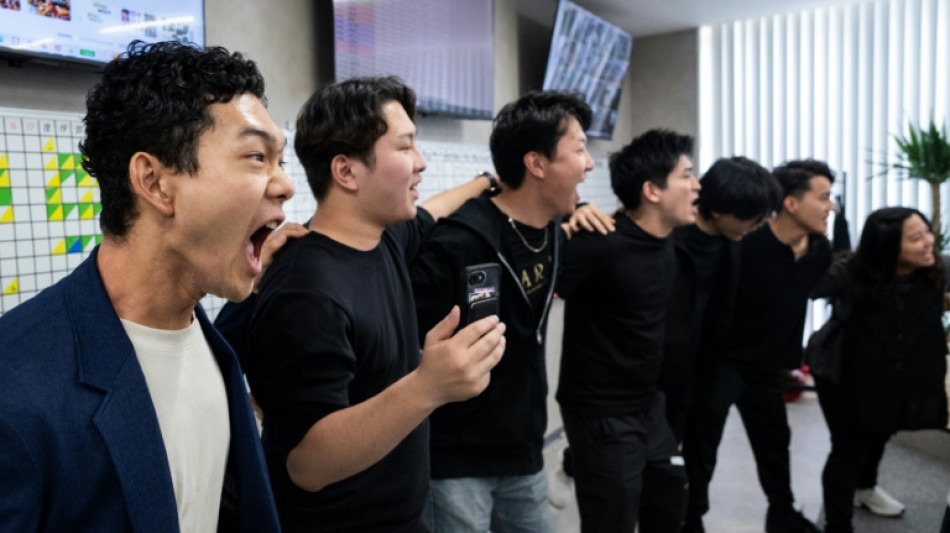
Huddled together shoulder-to-shoulder, Gen-Z hires at a Tokyo firm roared "Hell yeah!" to cap their morning rally, displaying the kind of corporate machismo that fuelled Japan's post-war economic miracle.
Once a bastion for "corporate warriors" fiercely devoted to their jobs, Japan has spent the past decades shifting towards a better work-life balance with greater emphasis on mental health.
But a small cohort of Gen-Z workers in the world's fourth-largest economy is seeking to emulate that bygone zeal, disenchanted with "soft" modern workplace culture they see as hindering growth.
At Global Partners, a business support and development firm, workers form a circle every morning, sway rhythmically and rapid-fire mantras like "build up sales!" in throat-shredding screams, with someone randomly chosen to pep-talk the crowd in a test of mettle.
The company has become an internet sensation and draws young hires longing to be toughened up, including 26-year-old employee Kotaro Kawabata.
"Here, it's like 'boom' right off the bat. Everyone is like 'Alright, let's all get to work!' -- I absolutely love it," he told AFP.
One of a dozen motivational Post-it notes adorning his computer reads, "Kotaro, you're the number one salesman."
"I can really grow here. They're strict with me and they even get mad at me for the sake of my development," Kawabata said.
Asuka Obri Okabe, too, welcomed wholehearted scoldings, which she treated "as a form of love", the 28-year-old told AFP.
"What's truly scary is an environment where I'm never corrected, and left to move forward in the wrong direction."
A 2023 survey by research firm Recruit Works Institute showed that 64 percent of middle managers in Japan scold their subordinates no more than "a few times" a year.
Gone are the days when tough love and the "homogeneity of male full-timers" steered corporate Japan, Shoto Furuya, the institute's chief researcher, told AFP.
A rapidly greying population has left the country reliant on wide-ranging talent, including those who "don't see work as the main focus of their lives," he said.
The 2015 suicide of an exhausted 24-year-old employee at advertising giant Dentsu also forced Japan's corporate world to reckon with "karoshi" -- death from overwork.
"But the laid-back, low-pressure environment wasn't the right answer for everyone," with some young go-getters now quitting in frustration and desiring a return to "that 'gung-ho' sports-team atmosphere," Furuya said.
GP's high-energy culture "is a reminder of what Japan lost" and "how its post-war companies used to function as extremely tight-knit communities," he said.
- Quiet quitters -
At GP, workers unite over "zoss" -- a radical, masculine abbreviation of "otsukaresama-desu (Thank you for your work)" -- that they incessantly exclaim as their go-to greeting.
The firm uploads videos of its high-octane pep rallies and workers being reprimanded to promote zoss culture, prompting social media users to label it "cult-like" and "sadistic".
GP founder and CEO Koji Yamamoto, 54, bemoaned what he described as Japan's embrace of Western woke values that he believes began around 2000.
Political correctness and cancel culture, he said, "eviscerated the mental grit" behind Japan's post-war economic success.
Workers today are left "too afraid to even say 'do your best' to (each other) or to shake hands" for fear of being accused of harassment, Yamamoto said.
Hence GP's internal motto: "Holding back is evil."
"If you don't say anything because you don't want to rock the boat, you end up 'quietly quitting,'" he told AFP.
A recent survey by job-matching service Mynavi showed that half of Japanese workers in their 20s and 30s say they have mentally disengaged from their jobs.
GP employee Yuna Nagano, 19, agreed that workers in her generation "tend to lack enthusiasm, doing only what they are told to do".
"But here, we don't work just to be compensated for our time, so our productivity is much higher. I think this kind of mindset is conducive to Japan's economy," she told AFP.
Despite being an ardent believer in Japan's 63-year "Showa" era that lasted until 1989, CEO Yamamoto conceded some of its aspects -- including debilitating overwork and disregard for mental health -- should be left behind.
Parts of GP can be surprisingly modern: it has an international, gender-balanced workforce of mostly people in their twenties.
Employees freely sport shorts, sandals and dyed hair, and boast relatively high rates of paid leave usage.
In some respects "our society is far better today", Yamamoto said.
"That's why I say we should go back 90 percent to the Showa era, and keep 10 percent as it is now."
L.Chatterjee--MT