Kenya steps up crocodile hunt as rising lakes fuel conflict / Photo: Tony KARUMBA - AFP

Kenya's wildlife officers are trapping crocodiles on the shores of Lake Baringo in a bid to curb growing human-wildlife conflict as rising waters push the reptiles towards homes.
Lakes in Kenya's Rift Valley have risen to levels not seen in at least half a century, with scientists attributing the surge to extreme rainfall linked to climate change.
Tens of thousands of people have been displaced to higher ground, according to official data, and wildlife has been brought into dangerously close proximity with humans.
With the El Nino weather pattern threatening to worsen the situation in the coming weeks, Kenya's government launched a week-long operation late last week around Lake Baringo to relocate some of the larger crocodiles.
It is a tricky job.
One tactic involves playing a recording of a distressed dog through a speaker on the shore of the lake to lure crocodiles towards a net trap baited with dead fish.
AFP watched as officers instructed the crowd of curious locals to keep quiet and hide to avoid distracting the crocodile as they waited for it to move into the trap.
"Catching them is not easy, they are very shy... it is difficult to lure them... and dangerous," said Dominic Mijele, the Kenya Wildlife Service (KWS) veterinary officer in charge of the operation.
Several crocodiles were seen criss-crossing at the edge of the net, but officers said the reptiles have grown wary after at least five were captured at the same spot.
About 13 crocodiles have already been captured at the lake and transferred to a protected park, KWS said, with a target of at least 30 by the end of the operation.
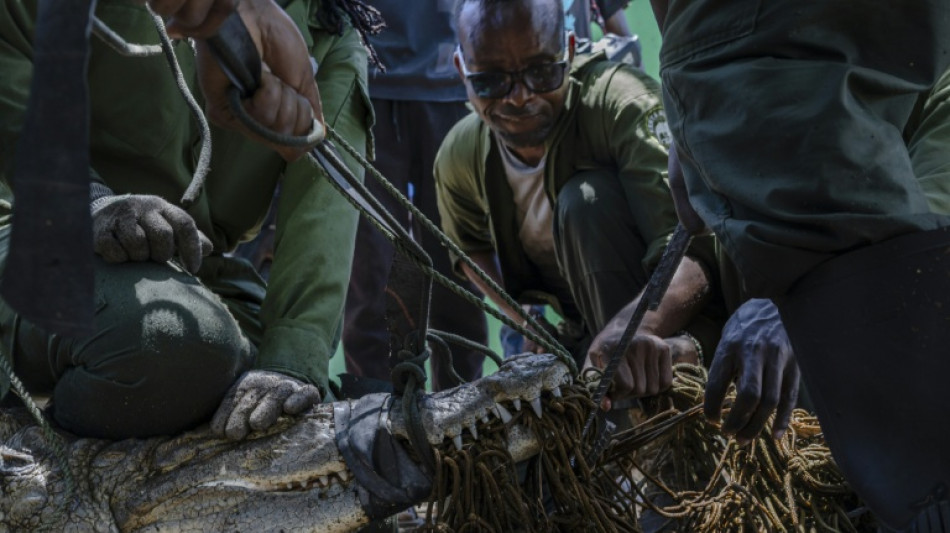
When one mid-sized crocodile finally entered the trap, a vehicle attached to the net reversed, hauling it out of the water and briefly suspending the reptile above the lake before officers pulled it ashore.
But the crocodile did not go quietly, thrashing and twisting as it tried to break free, while a group of KWS officers wrestled with the net for nearly 30 minutes to secure the croc.
"It is the one that has been disturbing me at my home every day," said a woman, who is a fishmonger and was among the crowd gathered to watch the captured reptile.
- 'Enough now' -
Lake Baringo is home to more than 200 crocodiles, according to a rough estimate by Mijele, with the operation targeting those weighing 200 kilos or more to help manage the population.
An AFP analysis of Copernicus Sentinel and NASA Landsat satellite imagery shows the lake has expanded by 70 percent since 2010 to cover 234 square kilometres (90.3 square miles).
"We fear that when the El Nino rains come, this water will continue rising and flush the crocodiles into the village," said Mijele.
At the fishing site, local fishmongers welcomed the crocodiles' translocation, saying it would make the area safer.
"It is a great relief, they have terrorised us for a long time... they destroy our fishing nets every day," said Dorcas Kiplagat, a 35-year-old fishmonger.
Yet some locals fear the move could hurt tourism and undermine businesses that rely on visitors.
"It is enough now... what are we going to show foreign tourists?" one middle-aged local said after the capture.
Q.Kulkarni--MT