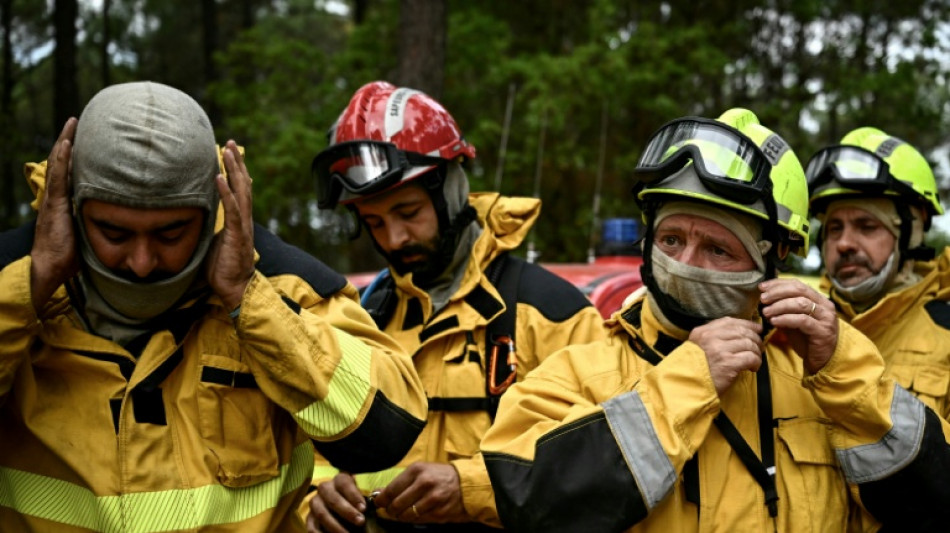
A side of oysters for France's flat-out firefighters / Photo: Philippe Lopez - AFP

As the smoke from France's worst wildfire in over 75 years rose over the Bassin d'Arcachon, a pair of nearby firefighters tucked into a plate of oysters plucked from the bay west of Bordeaux.
Accompanied by a spritz of juice from unwaxed lemons cut into zigzag wedges with restaurant precision, their mid-shift seafood spread was far from atypical of the meals prepared for the 3,300-strong fire brigade by a legion of enthusiastic volunteers, in a country that prides itself on its gastronomy.
"We've got a strong bond with the oyster farmers, hunters and farmers, who are all part of the region's fabric," said Florian Gazeau, a volunteer at a makeshift resting post near the beach resort of Lanton where scores of firefighters were availing themselves of the wide range of delectable scran on offer.
"If someone has oysters they'll bring them along," added the 32-year-old communications specialist, who had been made redundant as a result of the blaze.
A few metres away, his mother Beatrice was busy ladling out and flipping crepes spread from brim to brim with a generous layer of chocolate-hazelnut spread.
Besides being a "comfort food" after a hard shift at the front, the snacks also make sure the firefighters have "more strength", she said.
"Of course, we try to choose local products and we work with local produce, and that's a great thing," the pancake-purveyor told AFP in the wake of the lunchtime rush by her catering van, which she willingly offered up for the food effort.
"Our terroir is something we truly take pride in."
- 'Go to waste otherwise' -
With restaurants among the buildings consumed in the wildfire's 42,000-hectare (104,000-acre) ravages, much of the produce on offer comes from local businesses who have been forced to shut as a result of the crisis.
"We had one restauranteur offer up 100 kilogrammes (220 pounds) of shrimp," said Jean-Pierre, a caterer who declined to give his last name, as a fellow volunteer laid out wafer-thin slices of ruby-red raw beef carpaccio in the broad sunlight.
"It'd all go to waste otherwise," he told AFP, while stirring a metre-radius metal pan perched atop a gas burner filled with ratatouille.
The ad-hoc canteens range in scale from a single food truck in a parking lot to field kitchens fit for an army.
At the buffet for the central command post in Lege-Cap-Ferret, it takes two full-size catering trays to contain the range of artisanal cheeses crumbling or oozing onto the warm metal for the firefighters' pleasure.
"It's grandiose, that's what they tell us," said Anne-Marie, who added that they had a several dozen-strong team of people working shifts around the clock and a sizeable chill room to house the perishable pile of donations.
"So it is!" chimed in an off-duty fireman nearby. "But it's the same everywhere."
- 'Giving us everything' -
Not everything served up would meet with approval from the steak-frites purists.
Pizza popped up as often as pate on plates, while one caterer from La Reunion has won social media adulation for his gifts of cari, a spicy dish popular on the Indian Ocean island.
For dessert, Proust's beloved madeleines and mirabelles jostled for attention with distinctly American-accented glazed doughnuts.
"People are giving us everything, water, food," firefighter Cyril Veniere told AFP. "It helps us to stay upright."
Besides water, much needed for the hours spent sweating in the swelter, his firetruck is chock-a-chocolate block with gifts of cakes, fruit compotes and other kind offerings.
"We're doing it for them, and they're almost ready to hand us the key to their houses," said fellow firefighter Teddy Rousselet.
Many helping to keep the firefighters fed felt they owed them a debt of gratitude.
The fire brigade saved "not just our home but our business premises too", said Manu Goncalves, doling out portions of roast chicken alongside his neighbours' courgettes with his son Theo and niece Manon.
"We've been there since the beginning," Goncalves said in the carbonised town of Le Porge, which has seen some 12 percent of its buildings go up in smoke. And he counts on being there "until the flames are gone".
But while much of the food might be gloriously Gallic, Jean-Pierre, the Lanton caterer, insisted that the rush to feed the firefighters was not an exclusively French phenomenon.
"I think that people would have pulled themselves together wherever."
V.Chauhan--MT