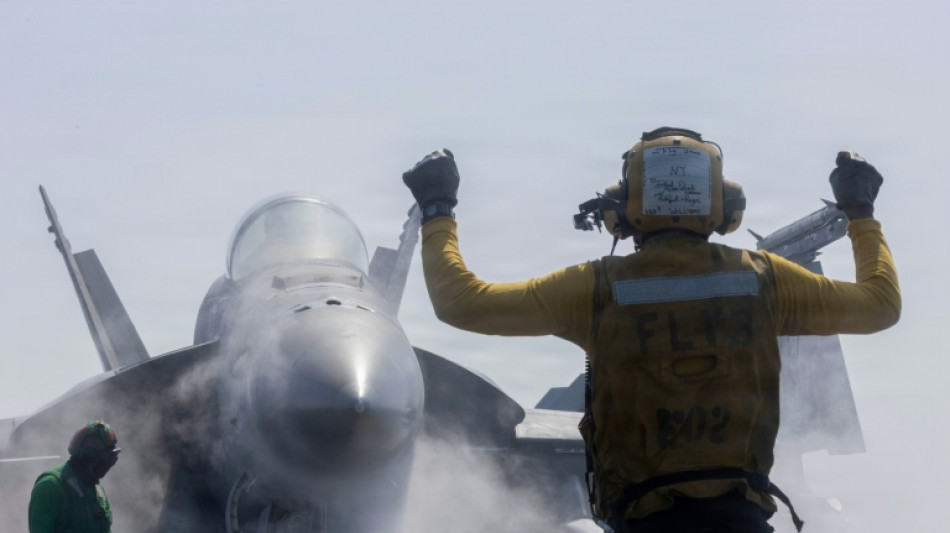
Energy prices soar, stock markets slide on Iran war fallout / Photo: - - US NAVY/US CENTRAL COMMAND/AFP

Oil and gas prices soared, stock markets slid and the dollar firmed on Monday as the widening Iran war shook financial markets across the globe.
European natural gas prices rocketed more than 20 percent and world crude futures surged around eight percent on fears of disruption to Middle East energy supplies.
Asian and European stock markets retreated as much as around two percent as investors exited trades in favour of the dollar and gold, seen as safer bets in times of economic unrest.
The greenback jumped nearly one percent against the British pound, while the precious metal rose 2.1 percent to $5,389.5 an ounce.
There were sizeable gains to share prices of energy majors and defence companies, with BAE Systems jumping six percent in London.
"Investors are scuttling towards safe havens, seeking shelter as conflict widens in the Middle East," noted Susannah Streeter, chief investment strategist at Wealth Club.
After US and Israeli strikes on Iran over the weekend, Israel bombarded Lebanon on Monday following rocket fire from Hezbollah.
Several American warplanes crashed in Kuwait and Iran lashed out against the region with missiles as the war expanded.
The bombings have also seen the vital Strait of Hormuz -- through which around 20 percent of global seaborne oil passes -- effectively shut and several ships attacked.
Airline share prices took a battering as carriers were forced to cancel flights to and from the Middle East -- with Qantas, Singapore Airlines and British Airways owner IAG each losing around five percent.
Air France-KLM shed more than eight percent in late morning Paris deals.
However, energy firms rallied, with Australia's Woodside Energy jumping more than six percent, PetroChina and TotalEnergies adding almost four percent and Shell nearly three percent.
"If higher oil prices persist, it raises the risk of stickier headline inflation," wrote Saxo Markets' Charu Chanana.
This could prove troublesome for US President Donald Trump, who has promised his electorate low prices, as the United States approaches mid-term elections in November.
Rising energy prices, increased shipping costs and loss of revenue for air transport could have "a harmful effect on growth", said economist Eric Dor from the IESEG School of Management in Paris.
"If it's a matter of three days, it's not serious. But if it's over a longer period, then it will have an additional recessionary effect," he told AFP.
In theory, oil-importing countries have reserves, with OECD members required to maintain 90 days' worth of stocks, but prices above $100 cannot be ruled out according to analysts.
If the disruption at Hormuz continues, "no matter how much spare capacity, (it) is not going to fill that gap. That gap is just too big," said Amena Bakr, head of Middle East and OPEC+ research at analysts Kpler.
Key members of the OPEC+ oil cartel on Sunday announced a greater-than-expected increase to production quotas.
- Key figures at around 1030 GMT -
Brent North Sea Crude: UP 8.0 percent at $78.65 per barrel
West Texas Intermediate: UP 7.5 percent at $72.02 per barrel
London - FTSE 100: DOWN 0.8 percent at 10,827.47 points
Paris - CAC 40: DOWN 1.5 percent at 8,450.04
Frankfurt - DAX: DOWN 1.7 percent at 24,861.80
Tokyo - Nikkei 225: DOWN 1.4 percent at 58,057.24 (close)
Hong Kong - Hang Seng Index: DOWN 2.1 percent at 26,059.85 (close)
Shanghai - Composite: UP 0.5 percent at 4,182.59 (close)
New York - Dow: DOWN 1.1 percent at 48,977.92 (close)
Euro/dollar: DOWN at $1.1739 from $1.1823 on Friday
Pound/dollar: DOWN at $1.3385 from $1.3486
Dollar/yen: UP at 156.89 yen from 156.03 yen
Euro/pound: UP at 87.73 pence from 87.67 pence
burs-bcp/rlp
C.Gupta--MT