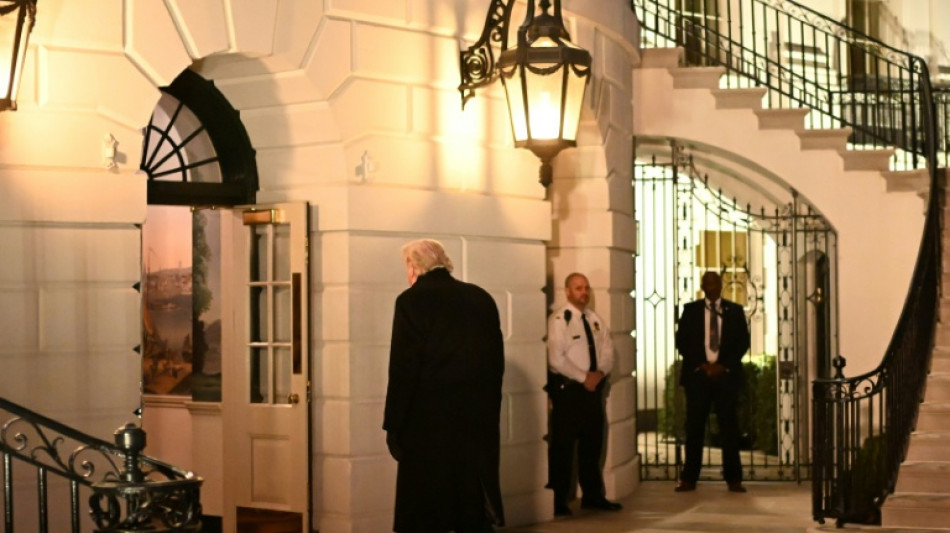
Trump in trouble on immigration, as signature issue turns deadly / Photo: Alex WROBLEWSKI - AFP

Donald Trump's immigration crackdown across the United States is the signature issue of his second term -- but deadly violence in Minneapolis risks making it a liability for a president who already looks vulnerable in the polls.
Outrage over the death of nurse Alex Pretti -- the second US citizen killed by federal agents this month while protesting militarized immigration raids in the city -- has forced Trump on the defensive.
The raids were a cornerstone of Trump's election pledges, but they are making even some of the Republican's core voters uncomfortable one year after his return to power.
Combined with multiple polls showing declining approval for the 79-year-old overall, alarm bells now appear to be ringing ahead of crucial US midterm elections in November.
"There is support for the idea of tougher immigration, but there is real pushback on the means and the methods being used, the heavy-handedness, the violence," Garret Martin, professor of international relations at American University, told AFP.
Recent polls show that even when voters approve of Trump's deportations and hard line on immigration, they oppose the often brutal methods of his Immigration and Customs Enforcement (ICE) agents.
A Siena/New York Times poll last week found the number of those who think ICE tactics have "gone too far" has ticked up over the past year to 61 percent.
The poll was carried out before Pretti's killing -- but after mother of three Renee Good, also 37, was shot dead by an ICE agent in Minnesota on January 7.
A YouGov poll carried out hours after Pretti's shooting, a majority of 46 percent -- 34 percent strongly and 12 percent somewhat -- support "abolishing ICE."
"It's a problem for the president because it means that the focus of the conversation is much more now on ICE and the scrutiny on how ICE is acting, as opposed to the issue of immigration, which Trump would like to put forward," said Martin.
- 'Rock and a hard place' -
Worse for Trump is that allies have soured on the crackdown.
Influential podcaster Joe Rogan earlier this month compared ICE raids to the Gestapo in Nazi Germany, while the normally loyal Texas Governor Greg Abbott urged Trump on Monday to "re-calibrate" his approach in Minnesota.
Trump scrambled to pivot on Monday, taking a more conciliatory tone with local Democrat leaders and dispatching his border chief to the state.
But it it has further pierced the aura of invincibility that Trump has sought to project since returning to power a year ago.
Polls show that Trump is on the back foot on a series of issues, most notably the economy that he boasted he would return to a new "golden age."
A series of polls also show that Trump is losing support among the groups that helped him get reelected in 2024, including Hispanic, Black and and young voters.
A Pew Research Center survey showed that 61 percent of Hispanic voters are dissatisfied with the US president's economic policies and that 65 percent reject his anti-immigration policies.
Trump has responded in typical fashion to such polls -- saying last week that he would sue the New York Times over the Siena survey and suggesting that what he called "fake" surveys should criminalized.
But that's unlikely to ease concerns among Republicans about the midterm elections on November 3.
Minnesota Republican Chris Madel, a defense attorney for Renee Good's shooter, dropped out of the race for governor Monday, saying "national Republicans have made it nearly impossible for a Republican to win a statewide election in Minnesota."
Traditionally a chance for voters to give incumbent presidents a hammering, Trump's party is at risk of losing control of one or both chambers of Congress -- although the leaderless Democrats also have dismal ratings.
But despite Trump's poll numbers, Republican lawmakers still have to contend with a deeply loyal "Make America Great Again" base in an election that Trump wants to make about himself.
"They're caught between a rock and a hard place," said Martin.
M.Shukla--MT