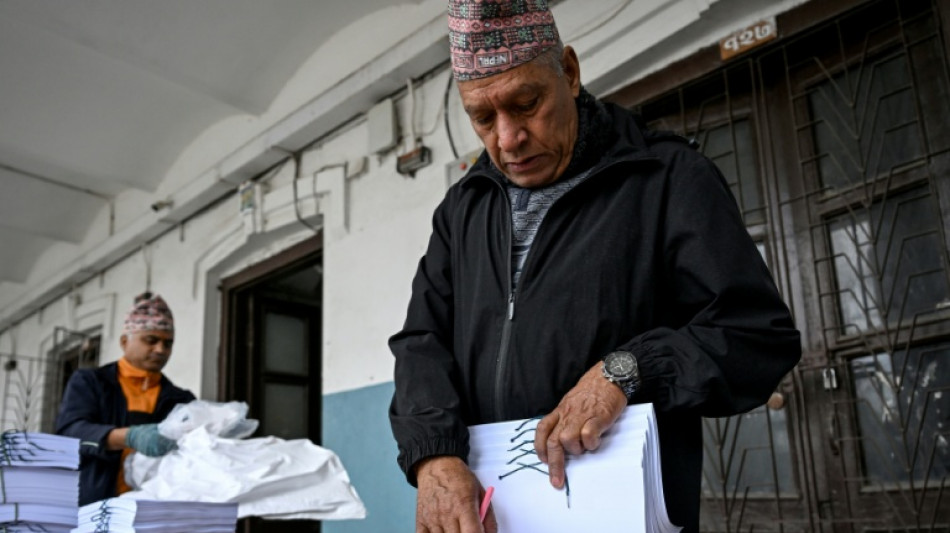
Nepal's youth lead the charge in the upcoming election / Photo: Prakash MATHEMA - AFP

Kishori Karki, 25, has been seeking blessings from elders in her community as the young candidate prepares to fight for change ahead of Nepal's landmark election next month.
The 25-year-old is among a slate of fresh faces on the March 5 ballot and said fighting against corruption and elevating youth demands are among her highest priorities.
"Our demands and aspirations should not be sidelined," she said while speaking with AFP in her hometown of Okhaldhunga in eastern Nepal.
Kishori had just graduated from law school and moved to Kathmandu in September when deadly youth‑led anti‑corruption protests erupted in the region.
A video of the young candidate taking an injured demonstrator to the hospital on a motorbike became one of the movement's defining images.
The two-day demonstrations had initially been triggered by rage over a brief government ban on social media and were spearheaded by young protesters under the loose "Gen Z" banner.
But their anger ran deeper: years of economic stagnation and entrenched corruption had primed the country of 30 million for upheaval.
The resulting violence killed 77 people, wounded scores and saw hundreds of buildings torched.
"After the Gen Z movement, if educated youth like us stand back, then the same old parties will play the same game," Kishori explained.
Kishori is running under the newly formed Ujyalo Nepal Party, led by former minister Kulman Ghising, who won significant public support for easing the country's chronic power shortages.
Former chief justice Sushila Karki, no relation to Kishori, is serving as interim prime minister until the vote.
-'New generation'-
Members for the 275-seat House of Representatives, the lower chamber of parliament, will be voted in -- with 165 members chosen in a direct vote and 110 through proportional representation.
A total of 3,406 candidates have registered for the direct election, of which 30 percent are under the age of 40.
"If you look at the candidates, the bigger portion are the new generation," said Prakash Nyaupane, spokesperson for the election commission.
Younger candidates are "a bit different", Nyaupane said, adding that "some older leaders have had to step back because of this".
Kathmandu's rapper-turned-mayor Balendra Shah, who resigned from his position to join the Rastriya Swatantra Party (RSP), is also a strong contender.
A prime minister hopeful, Shah will challenge ousted premier KP Sharma Oli in his eastern Nepal stronghold, Jhapa.
Shah told AFP that the protest had "opened a door" for new faces to enter politics, while raising the importance of governance among younger constituents.
Sudan Gurung — a key figure of the September unrest — is also running for the RSP from the Gorkha district in central Nepal.
Gurung, 38, has been urging families in his constituency to "vote for the right person".
Meanwhile, further west in the Rukum district, 28-year-old Sandeep Pun will challenge ex-rebel leader and Maoist chief Pushpa Kamal Dahal, also known as Prachanda, a term that means "fierce" in Nepali.
Several new parties and alliances have emerged nationwide, recruiting fresh and popular faces in a bid to reconnect with disillusioned voters, members have said.
Though many young candidates are also running in the election independently.
"It does seem that the September protest has galvanised young people to take part in politics, and not just as candidates," said journalist Pranaya Rana, who covers politics in the region.
-'Back on track'-
Civil war engulfed Nepal, a former monarchy, for more than a decade until a peace deal brokered in 2008 saw Maoist insurgents brought into government.
A revolving door of ageing prime ministers and a culture of horse-trading between the three dominant parties, however, has fuelled public frustration.
"It is very difficult for us to again be fooled by promises from the people who have already been in parliament so many times," said Manjil Rana, 37, a candidate for the Ujyalo Nepal Party in Tanahu.
"The recent revolution was a lot about young people, their voices and them participating in the government."
There are some 18.9 million eligible voters, including more than 800,000 first-time voters, according to the latest election commission data reviewed by AFP.
Sachin Timalsena, a 33-year-old candidate from Nepali Congress, said Nepal was at a "critical juncture", and the elections could bring the country back on track.
"I think the environment is supportive of the youth. I feel our society is ready for young people," he said.
I.Pandey--MT