UN touts panel for 'human control' of AI at global summit / Photo: Stephane LEMOUTON - POOL/AFP

A UN panel on artificial intelligence will work towards "science-led governance", the global body's chief said Friday as leaders at a New Delhi summit weighed their message on the future of the booming technology.
But the US delegation warned against centralised control of the generative AI field, highlighting the difficulties of reaching consensus over how it should be handled.
The flip side of the gold rush surrounding AI is a host of issues from job disruption to misinformation, intensified surveillance, online abuse and the heavy electricity consumption of data centres.
"We are barrelling into the unknown," UN chief Antonio Guterres told the AI Impact Summit in New Delhi. "The message is simple: less hype, less fear. More facts and evidence."
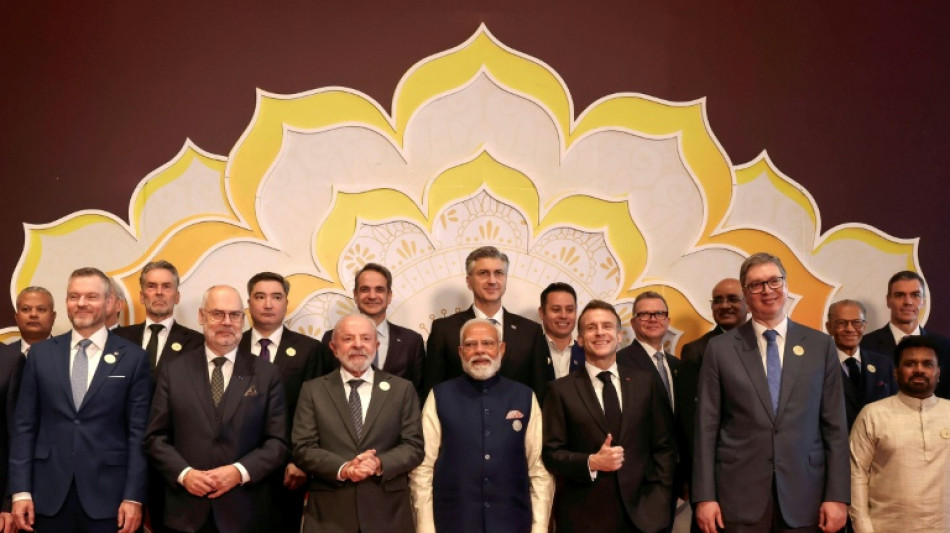
To cap the five-day summit, dozens of world leaders and ministers are expected to deliver on Friday a shared view on the benefits of AI, such as instant translation and drug discovery, but also the risks.
It is the fourth annual global meeting focused on AI policy, with the next to take place in Geneva in the first half of 2027.
Guterres said the United Nations General Assembly has confirmed 40 members for a group called the Independent International Scientific Panel on Artificial Intelligence.
It was created in August, aiming to be to AI what the UN's Intergovernmental Panel on Climate Change (IPCC) is to global environmental policy.
"Science-led governance is not a brake on progress," Guterres said. "When we understand what systems can do -- and what they cannot -- we can move from rough measures to smarter, risk-based guardrails."
"Our goal is to make human control a technical reality -- not a slogan."
White House technology adviser Michael Kratsios, head of the US delegation, warned that "AI adoption cannot lead to a brighter future if it is subject to bureaucracies and centralised control".
"As the Trump administration has now said many times: We totally reject global governance of AI," he said.
- 'Shared language' -
The Delhi gathering is the largest AI summit yet, and the first in a developing country, with India taking the opportunity to push its ambitions to catch up with the United States and China.
India expects more than $200 billion in investments over the next two years, and this week US tech titans unveiled a raft of new deals and infrastructure projects in the country.
Sam Altman, head of ChatGPT maker OpenAI, has called for oversight in the past but said last year that taking too tight an approach could hold the United States back in the AI race.
"Centralisation of this technology, in one company or country, could lead to ruin," he said Thursday, one of several top tech CEOs to take the stage.
"This is not to suggest that we won't need any regulation or safeguards. We obviously do, urgently, like we have for other powerful technologies."
The broad focus of the summit, and vague promises made at its previous editions in France, South Korea and Britain, could make concrete commitments unlikely.
Even so, "governance of powerful technologies typically begins with shared language: what risks matter, what thresholds are unacceptable," Niki Iliadis, director of global AI governance at The Future Society, told AFP.
Discussions at the Delhi summit, attended by tens of thousands of people from across the AI industry, have covered big topics from child protections to the need for more equal access to AI tools worldwide.
"We must resolve that AI is used for the global common good," Indian Prime Minister Narendra Modi told the event on Thursday.
V.Subramanian--MT