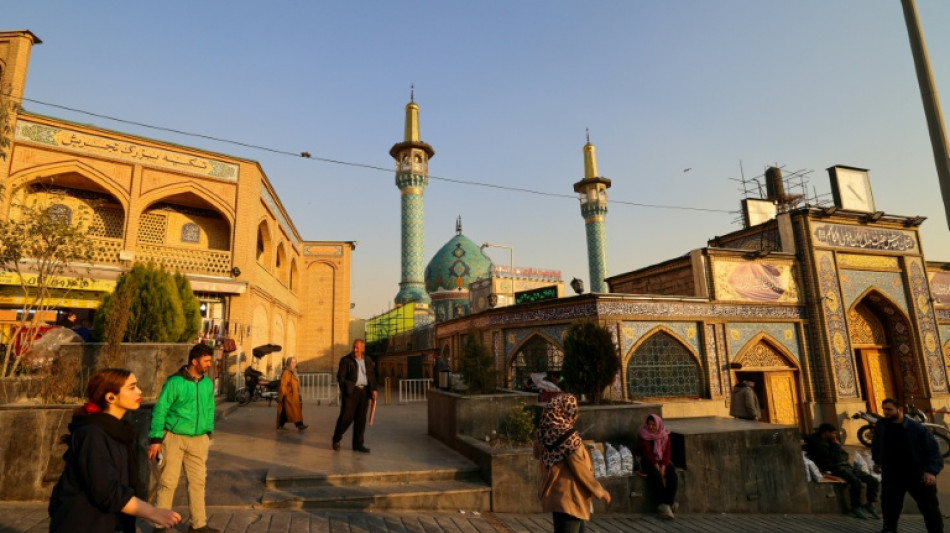
Iran vows to defend itself but sees diplomatic solution to US standoff / Photo: Atta KENARE - AFP

Iran's top diplomat said Sunday that his country would strike back at US interests in the Middle East in the event of an attack, though he still saw a chance for a diplomatic resolution.
Speaking to US broadcaster CBS, Foreign Minister Abbas Araghchi said he expected new talks on the details of a deal, "probably" Thursday, as fears loomed of renewed conflict after Washington carried out a major redeployment of military assets to the region.
US threats of military action have multiplied since a nationwide protest movement sparked a major crackdown that rights groups say killed thousands of people.
On Sunday, Iranian students held competing pro- and anti-government protests at several universities, with critics of the clerical leadership risking arrest or worse if they are caught.
"If the US attacks us, then we have every right to defend ourselves," Araghchi said, alluding to American interests in the region as potential targets.
Still, he said, "there is a good chance to have a diplomatic solution".
After a recent round of talks in Geneva, Iran said it was preparing a draft proposal for an agreement that would avert military action.
"I believe that when we meet, probably this Thursday in Geneva again, we can work on those elements and prepare a good text and come to a fast deal," Araghchi told CBS.
Axios had earlier reported, citing an unnamed senior US official, that if Iran submitted its proposal in the next 48 hours, Washington was ready to meet again later in the week "to start detailed negotiations".
The US has sent two aircraft carriers to the Middle East in recent weeks, along with other jets and ships, and has also shored up its air defences in the region to back up its threats of military intervention.
US President Donald Trump's chief Middle East negotiator Steve Witkoff said Saturday in a Fox News interview that the president was questioning why Iran had not yet given in to US pressure.
"He's curious as to why they haven't... I don't want to use the word 'capitulated', but why they haven't capitulated," he said.
"Why, under this pressure, with the amount of seapower and naval power over there, why haven't they come to us and said, 'We profess we don't want a weapon, so here's what we're prepared to do'?"
Western governments fear Iran's nuclear programme is aimed at developing a bomb, which Tehran has long denied, though it insists on its right to enrich uranium for civilian purposes.
On the subject of enrichment, Araghchi said Sunday: "As a sovereign country, we have every right to decide for ourselves, by ourselves."
- Fears of war -
A previous round of diplomacy last year was interrupted by Israel's bombing campaign against the Islamic republic.
That sparked a 12-day conflict in June that the US briefly joined with strikes on nuclear facilities.
Despite the recent Oman-mediated talks, Iranians' fears of a new conflict have grown.
"I don't sleep well at night even while taking pills," Tehran resident Hamid told AFP, saying he worried for his "family's health... my kids and grandchildren".
IT technician Mina Ahmadvand, 46, believes that "at this stage, war between Iran and the US as well as Israel is inevitable and I've prepared myself for that eventuality".
"I don't want war to happen, but one should not fool around with the realities on the ground."
The concerns have prompted several foreign countries to urge their citizens to leave Iran, including Sweden, Serbia, Poland and Australia, which warned "commercial flights are currently available but this could change quickly".
- Protests -
Iran has previously said that quickly striking a deal is in its interests if means relief from sanctions that have hamstrung its economy, which contributed to protests late last year over the high cost of living.
Those demonstrations quickly expanded into mass anti-government protests that marked one of the largest challenges to the Islamic republic's leadership in years, prompting a deadly crackdown by authorities that saw thousands killed, according to rights groups.
On Sunday, Iranian students gathered for fresh pro- and anti-government rallies commemorating those killed following similar gatherings the day before.
Local and diaspora media outlets reported demonstrations at multiple Tehran universities, with some participants waving the flag of Iran's deposed monarchy, and others chanting "death to the shah", who was toppled by the 1979 Islamic revolution.
Trump had initially cheered on the protesters, threatening to intervene on their behalf amid the crackdown, but his threats soon shifted to Iran's nuclear programme.
V.Chauhan--MT