Israel and Lebanon set for ceasefire talks next week, says US official / Photo: Ibrahim AMRO - AFP

Israel and Lebanon will hold talks next week in Washington, a State Department official said Thursday, as concerns grow that fighting involving Hezbollah could cause the fragile US-Iran truce to unravel.
Israel's heaviest bombardment on Lebanon since Hezbollah entered the Middle East war in early March killed hundreds on Wednesday, shaking the ceasefire between Washington and Tehran less than 48 hours after it came into force.
"We can confirm that the Department will host a meeting next week to discuss ongoing ceasefire negotiations with Israel and Lebanon," the official said, confirming an earlier account from a source familiar with the diplomatic efforts.
Israel's Prime Minister Benjamin Netanyahu had earlier on Thursday ordered his ministers to seek direct talks with Lebanon, pushing for Iran-backed Hezbollah's disarmament.
But a Lebanese government official told AFP after Netanyahu's announcement that Beirut required a truce before starting any negotiations with Israel, a day after the deadly strikes across Lebanon.
"Lebanon wants a ceasefire before starting negotiations," said the Lebanese government official, who has knowledge of the matter and requested anonymity.
Neither Israel nor Lebanon have publicly confirmed the US talks for next week.
Lebanese authorities said Israeli strikes killed at least 303 people and wounded 1,150 in the bombardment on Wednesday, while Hezbollah said it was engaged in close quarters combat against Israeli forces on the ground a day later in southern Lebanon.
Israel's army Chief of Staff Eyal Zamir visited ground troops inside Lebanon on Thursday, telling them Hezbollah suffered a "heavy blow" from the strikes a day earlier.
Netanyahu's order for direct negotiations with Lebanon's government was focused on disarming Hezbollah and establishing peace, according to a statement from his office, but he offered no immediate respite from the aerial attacks.
A Hezbollah lawmaker later reiterated his group's "rejection of any direct negotiations between Lebanon" and Israel.
- 'Inseparable' -
Even as Netanyahu spoke, Israel's military issued a new evacuation order for Beirut's southern suburbs.
Later Thursday, Israel's army said it was striking Hezbollah launch sites in Lebanon. It also warned Israeli citizens that the militant group may expand fire "in the coming hours".
Brussels, Moscow and Ankara demanded that the US-Iran ceasefire be extended to Lebanon.
"We view the situation in southern Lebanon with particular concern," Germany's Chancellor Friedrich Merz said, echoing statements from Paris and London.
"The severity with which Israel is waging war there could cause the peace process as a whole to fail, and that must not be allowed to happen."
For their part, Iran's parliamentary speaker Mohammad Bagher Ghalibaf said Tehran sees Lebanon as an "inseparable part of the ceasefire" and President Masoud Pezeshkian said Israel's strikes rendered "meaningless" talks with US envoys planned for the end of the week in Pakistan.
Iran's new supreme leader Mojtaba Khamenei in his latest written message said that the Islamic republic does not want war with the US and Israel but would protect its rights as a nation.
- 'Where is Hezbollah here?' -
Hezbollah said it had fired rockets towards Israel on Thursday in response to what it called a violation of the ceasefire.
But both Israel and the US insist the fighting in Lebanon is not covered by the ceasefire.
"We are continuing to strike Hezbollah with force, precision and determination," Netanyahu said, in a social media post.
"Our message is clear: anyone who acts against Israeli civilians, we will strike them. We will continue to hit Hezbollah wherever necessary."
President Donald Trump claimed victory in the Middle East war after agreeing the two-week truce with Iran to allow talks between American and Iranian negotiators to end a conflict that has already killed thousands and plunged the global economy into turmoil.
Tehran's ambassador to Pakistan, meanwhile, deleted a social media post saying an Iranian delegation would arrive in Pakistan on Thursday.
An official at the Iranian embassy in Islamabad told AFP the post was removed "because of some issues" and refused to say whether the delegation was still expected.
Trump told NBC News on Thursday he was "very optimistic" about a peace deal with Iran after their ceasefire, and that Israel was "scaling back" strikes in Lebanon.
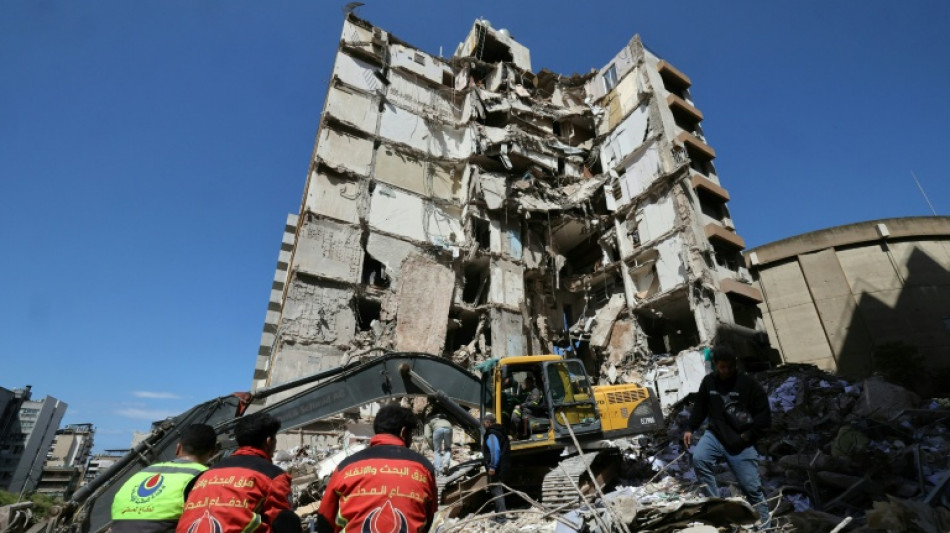
According to the civil defence, several bodies were still under the rubble following Wednesday's strikes on Lebanon.
"We don't know where my niece is... the rescue teams have been working tirelessly since yesterday, but they haven't found her," Beirut resident Taha Qarqamaz told AFP.
"Look, these are school notebooks, class notes, books! Where is Hezbollah here? There is no Hezbollah in this neighborhood!" protested his friend, Khaled Salam.
- High-stakes talks -
If the Pakistan talks go ahead, a key point of contention remains the Strait of Hormuz, through which a fifth of the world's oil as well as vast quantities of natural gas and fertilizer pass in peacetime.
Iran announced alternative routes on Thursday for ships travelling through the strait,citing the risk of sea mines.
MarineTraffic data showed that the Gabon-flagged MSG passed through the strait on Thursday, the first non-Iranian oil tanker to do so since the ceasefire was announced.
R.Deshmukh--MT