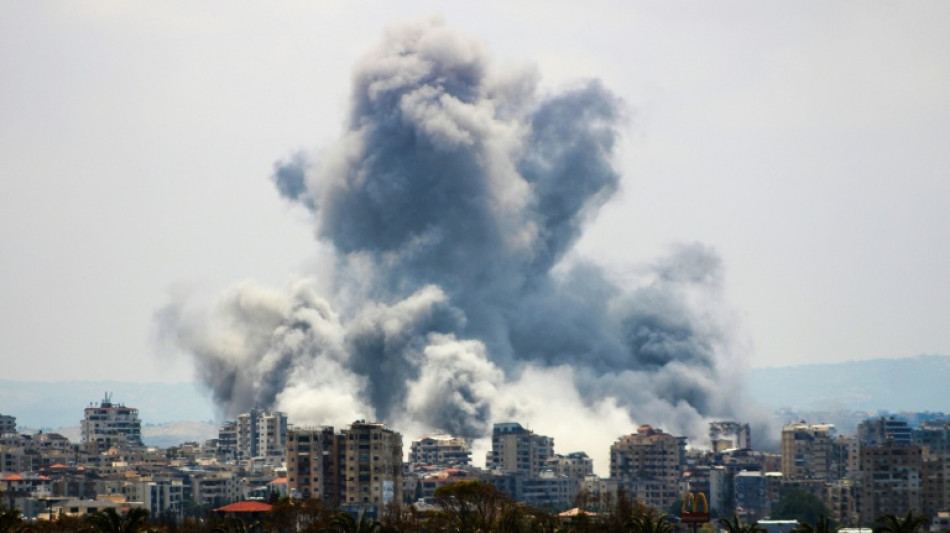
Israel orders strikes on Beirut ahead of UN meeting / Photo: KAWNAT HAJU - AFP

Israel said Monday it would once again target Beirut's southern suburbs, a Hezbollah stronghold mostly spared heavy attacks since April, as it stages its deepest incursion into Lebanon in two decades.
The UN Security Council is expected to hold an emergency meeting later Monday on Israel's expansion of its operations in Lebanon, and the European Union called on Israel to "stop its military escalation".
Iran, in stalled negotiations on an end to its wider war with the United States, said a Lebanon ceasefire remains a key condition for any deal.
Israel's Prime Minister Benjamin Netanyahu and Defence Minister Israel Katz said they had ordered strikes on Beirut's southern suburbs, a densely-populated area where Hezbollah holds sway.
"In light of the repeated violations of the ceasefire in Lebanon by the terrorist organisation Hezbollah and the attacks on our cities and citizens, Prime Minister Benjamin Netanyahu and Defence Minister Israel Katz have instructed the IDF to strike terror targets in the Dahiyeh district of Beirut," a joint statement said.
In a separate statement, Katz said there would be "no calm in Beirut" if Hezbollah attacks continued, and vowed to establish a military-controlled zone in the area of south Lebanon's Litani River.
Lebanon was dragged into the Middle East war on March 2 when Hezbollah fired rockets towards Israel in retaliation for the US-Israeli killing of Iran's supreme leader.
A truce to halt the fighting in Lebanon began on April 17, but has never been observed. Both Israel and Hezbollah accuse each other daily of violating the ceasefire, justifying their attacks by the other's alleged breaches.
- 'Vicious aggression' -
Iranian foreign ministry spokesman Esmaeil Baqaei told a weekly press briefing Monday that "a ceasefire in Lebanon is an essential condition for any deal aimed at ending the war" with the US.
Lebanese President Joseph Aoun meanwhile said his country was facing "a vicious and reprehensible Israeli aggression", with the two nations set to hold a fourth round of US-hosted talks on Tuesday.
An AFP correspondent saw families with small children packed onto scooters with just a bag or two leaving the southern suburbs Monday, as others fled in cars full of belongings.
Hadi, a 24-year-old, said he had hoped for some stability during the truce.
"That feeling did not last long... Our fears intensified this morning after I received a series of messages about orders to bomb the southern suburbs, which caused widespread panic, and we immediately left the area," he told AFP by phone.
Beirut's southern suburbs and their surroundings have been struck twice since April 8, when a series of Israeli attacks across Lebanon killed hundreds in minutes.
"The Dahiyeh in Beirut is no different from the communities in northern Israel -- if there is no calm in the north, there will be no calm in Beirut," Katz's statement said.
Monday's Israeli order comes a day after its troops seized Beaufort castle, which commands sweeping views of south Lebanon, as the military expands its ground operations.
Israeli forces used the castle, also known as Qalaat al-Chakif, as a base during their previous two-decade occupation of southern Lebanon that ended in 2000.
- Evacuation orders -
"The capture of Beaufort is a dramatic stage and a dramatic shift in the policy we are leading," Netanyahu said in a video statement.
Katz said Israel planned to "to turn the Litani area into a zone under IDF security control, free of weapons and terrorists".
French President Emmanuel Macron, whose country requested the UN Security Council meeting, said Sunday that "nothing justifies the major escalation under way in south Lebanon".
On Monday, Israel's military issued evacuation orders for nine towns and villages in southern Lebanon's Sidon and Jezzine districts, far from the border with Israel, Lebanon's state-run National News Agency reported.
Hezbollah meanwhile claimed responsibility for a missile fired on Tiberias, around 30 kilometres (19 miles) inside Israel. The Iran-backed group also said it attacked Israeli forces inside Lebanon.
A senior US official told AFP on Sunday that US Secretary of State Marco Rubio had spoken with Aoun and Netanyahu about the ongoing diplomatic negotiations and had said that Hezbollah must be the first to cease attacks.
Military delegations from Lebanon and Israel held security talks in Washington on Friday and more US-brokered negotiations are planned for Tuesday and Wednesday.
"To advance those talks, the United States proposed a clear sequence: Hezbollah must stop all attacks on Israel. In return, Israel would refrain from escalation in Beirut," said the official, who spoke on condition of anonymity.
Lebanon's health ministry says Israeli attacks have killed more than 3,412 people in the country since March 2.
Twenty-six Israelis have been killed, 25 soldiers and one civilian contractor, over the same period.
D.Kumar--MT