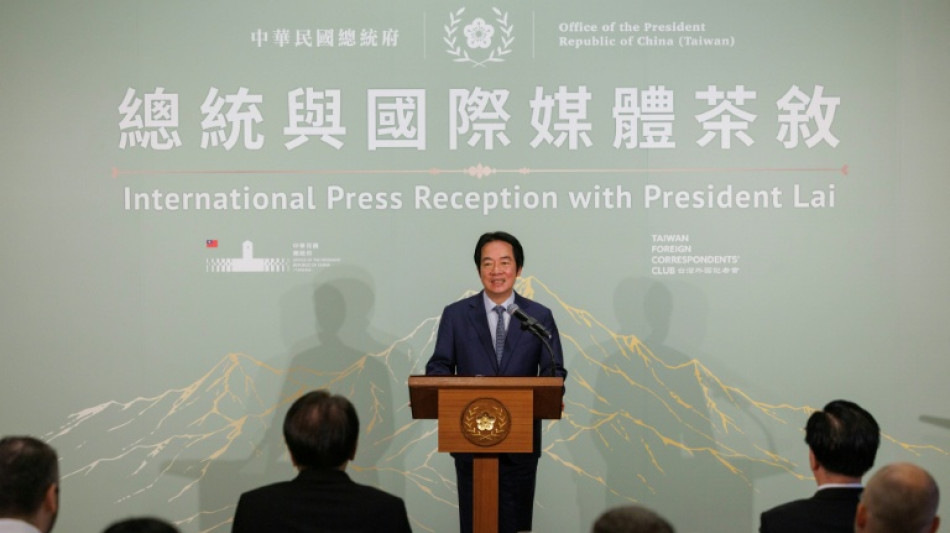
Taiwan president says hopes for $14 bn US arms sale 'as soon as possible' / Photo: CHENG Yu-chen - AFP

Taiwan's president said Thursday he hoped the United States would approve a $14 billion arms sale "as soon as possible", reiterating that the democratic island "rejects unification" with China.
Taipei relies heavily on Washington's support to counter growing pressure from Beijing, which claims Taiwan as part of its territory and has not ruled out seizing it by force.
"We hope that the arms purchases can be approved as soon as possible," President Lai Ching-te told reporters in Taipei.
"Taiwan's efforts to safeguard its national security, uphold its democratic and free way of life, and reject unification and the rule of the Chinese Communist Party should not be seen as a provocation against China or a troublemaker in the region," he said.
The United States formally recognises only China, but is bound by domestic law to provide Taiwan with the means to defend itself, a frequent source of tension between Washington and Beijing.
US Secretary of State Marco Rubio said earlier this month the proposed $14 billion package was "under review", while officials said in May they were assessing whether American weapons stockpiles were sufficient for its Iran operations.
Lai's government has vowed to increase overall defence spending to more than three percent of GDP this year.
It has proposed NT$1.25 trillion (US$40 billion) for weapons purchases, including US-developed arms as well as Taiwan-made drones and other items.
But Taiwanese lawmakers have disagreed over how much to spend on improving defence capabilities.
Opposition parties, which hold a majority in the legislature, passed a $25 billion special defence budget last month, slashing by a third the amount sought by Lai's ruling party.
The US's commitment to Taiwan's security "remains unchanged", Lai said, adding both parties "share the goal of strengthening security and accelerating efforts to strengthen Taiwan's self-defence capabilities".
- 'Increasing coercion' -
Lai also said China "exerted pressure" on Japan and the Philippines during their negotiations over maritime boundaries in waters east of Taiwan.
Tokyo and Manila said late May they would start formal talks to "delimit the maritime boundary" of their exclusive economic zones and continental shelf between them.
China called the talks "illegal" and has also claimed exclusive control over the waters concerned.
Taipei rejects Beijing's claims, insisting Taiwan and China are "not subordinate" to each other.
"China is not only pressuring Taiwan, but also other countries in the Indo-Pacific region," Lai said Thursday.
China's military expansion in the East and South China Seas and Taiwan Strait had extended to the western Pacific, he said, and its "various forms of coercion continue to increase".
Shared concerns over China's maritime claims have brought Japan and the Philippines closer in recent years.
Like most countries, neither recognises Taiwan's claim to statehood but both maintain close unofficial relations with the island.
K.Tiwari--MT