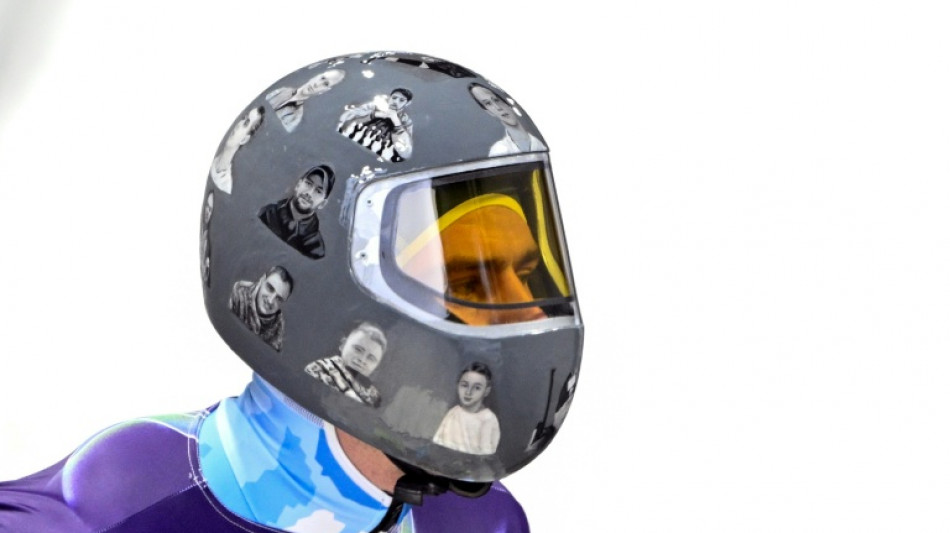
Ukraine skeleton racer Heraskevych banned from Olympics over memorial helmet / Photo: Tiziana FABI - AFP

Ukrainian skeleton racer Vladyslav Heraskevych was disqualified from the Winter Olympics on Thursday after refusing to back down over his banned helmet, which depicts victims of his country's war with Russia.
The athlete had insisted he would continue to wear the headgear, which carries pictures of Ukrainian sportsmen and women killed since Russian forces invaded Ukraine in 2022, in competition.
But the International Olympic Committee said Heraskevych had been kicked out of the Milan-Cortina Games after failing "to adhere to the IOC athlete expression guidelines".
Ukraine President Volodymyr Zelensky had defended the 27-year-old's right to wear the helmet but gestures of a political nature during competition are forbidden under the Olympic charter.
The IOC's decision was labelled a "moment of shame" by Ukrainian Foreign Minister Andriy Sybiga while a defiant Heraskevych posted on X: "This is (the) price of our dignity", alongside a picture of his helmet.
Heraskevych has the option to appeal to the Court of Arbitration for Sport but CAS told AFP it had not heard from him.
The IOC said in a statement that the skeleton racer's accreditation had been withdrawn after he had been given a final opportunity to change his mind.
"The decision followed his refusal to comply with the IOC's Guidelines on Athlete Expression," it said.
"It was taken by the jury of the International Bobsleigh and Skeleton Federation (IBSF) based on the fact that the helmet he intended to wear was not compliant with the rules."
Athletes are permitted to express their views in press conferences and on social media, and on Tuesday the IOC had said it would "make an exception" for Heraskevych, allowing him to wear a plain black armband during competition.
"Mr Heraskevych was able to display his helmet in all training runs," the IOC statement added. "The IOC also offered him the option of displaying it immediately after the competition when going through the mixed zone."
The Ukrainian told reporters at the Cortina Sliding Centre that he believed the decision was "totally wrong".
"Especially when we had already in this Olympic Games other cases, when athletes in almost equal situations were treated differently and didn't face any sanctions," he said.
"I have really bad thoughts, and I believe that this situation also plays along with Russian propaganda," he added.
- Powerful message -
IOC president Kirsty Coventry met with Heraskevych early on Thursday morning in a last-ditch attempt to persuade him to change his mind before his competition. Coventry was in tears after the meeting, according to video images.
"The president was very emotional about this because she invested a great deal of time in getting the athletes' expression guidelines over the line," IOC spokesperson Mark Adams told a briefing in Milan.
Kyiv reacted with fury to the decision to ban Heraskevych.
"The IOC has banned not the Ukrainian athlete, but its own reputation," Ukrainian Foreign Minister Andriy Sybiga said on social media. "Future generations will recall this as a moment of shame."
Ukraine's Sports minister Matviy Bidnyi threatened legal action.
Adams told the IOC briefing: "We dearly wanted him to compete. It would have sent a very powerful message.
"It is not about his message, it is not about the message he wanted to give, it is the place. We cannot have athletes having pressure put on them by their political masters."
Ukrainian fans outside the Cortina Sliding Centre expressed their dismay over the decision.
Irina Nalivayko, from Kyiv, said: "These people that he showed in his helmet, they're real people that died because of the Russian invasion," she said.
"The war is still going, we're still freezing, we still have no electricity. People are still dying and this is not good. It's unacceptable."
Heraskevych displayed a banner that read "No War in Ukraine" at the 2022 Beijing Winter Olympics, just days before Russia launching its invasion of its neighbour.
The conflict has resulted in a massive wave of destruction that has left entire cities in ruins and killed tens of thousands of soldiers and civilians, while forcing millions to flee their homes.
B.Chawla--MT