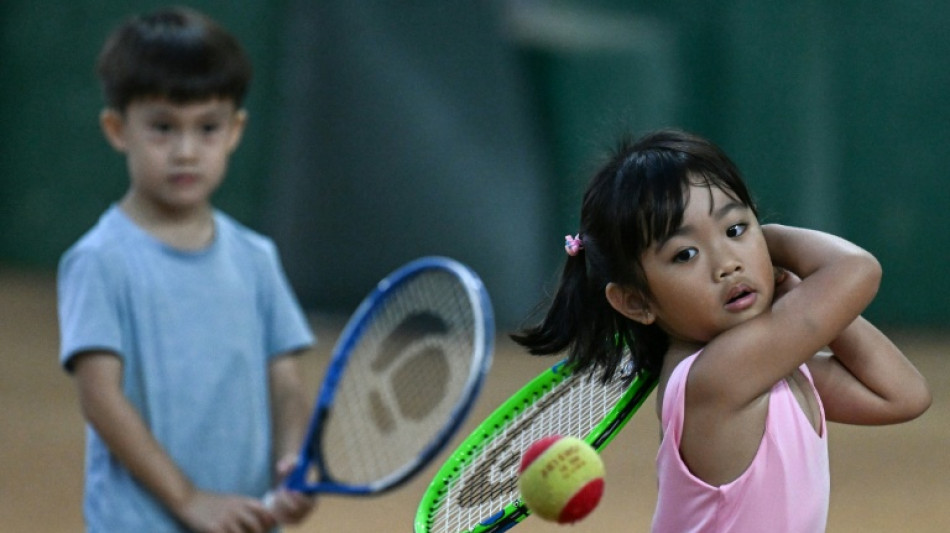
'I want to be Eala': Philippine sensation sparks tennis boom at home / Photo: Jam STA ROSA - AFP

On a Manila court made of crushed seashells, an earnest four-year-old sends a forehand sailing wide –- one of dozens of kids aiming to follow in the footsteps of the Philippines' first homegrown tennis sensation, Alexandra Eala.
The 21-year-old's rise has sparked a rush of interest in a sport typically seen as the preserve of the elite in a country best known for its love of basketball, boxing and cockfighting.
Racquet sales are up and scoring one of the few available playing venues has become next to impossible as parents cram their pre-schoolers onto practice courts.
"Apart from just bringing in people to watch, she's actually (got) people to play," Philippine Tennis Association (PhilTA) executive director Tonette Mendoza told AFP.
"Maybe the parents of these kids, they're thinking: Hey, if we do this, maybe they can be the next Alex," she said.
A now-famous photo of Eala diving flat out for a ball at Wimbledon's Centre Court was all it took to convince nine-year-old Mayumi Stevens.
"I felt like, wow, that's going to be me," Stevens told AFP as she waited to train alongside older pre-teens at the Alabang Tennis Academy in an exclusive Manila suburb.
"I want to be Eala when I grow up."
- 'Onto the bandwagon' -
French sporting goods retailer Decathlon is among the companies riding the Eala wave in the Philippines, busily reworking its store displays and social media after seeing sales of beginner racquets spike 66 percent in the past year.
"We really had to jump onto the bandwagon... creating content that's very relatable, that's very timely for whatever's happening with Alex right now," partnerships and communications manager Vince Roque told AFP.
PhilTA estimates there are fewer than 1,000 tennis courts in the sprawling archipelago.
Many are shell courts unique to the Philippines -- a mix of crushed seashells, sand and clay that cost less to build and maintain than red clay.
"It's super crazy to book tennis courts nowadays," said under-14 and under-12 national girls' team coach Czarina Arevalo, adding she never imagined she would see a Filipino in the world top 20.
Eala, a former US Open girls champion, made the leap to 20th in the WTA rankings just over a year after reaching her first Grand Slam tournament, the 2025 French Open.
The unexpected rise has spawned an army of loyal Filipino fans.
Many of the nation's 10 million-strong diaspora, forced overseas in search of better-paying jobs, are now paying hundreds of dollars for centre court seats and leaving traditional notions of prim tennis etiquette at the door.
"People were screaming like in a basketball match," PhilTA's Mendoza said of Eala's appearance at the Australian Open earlier this year.
Some "had never watched a tennis match in their entire lives", Mendoza said, adding the level of excitement was understandable. "She's our first who's gone this far".
After reaching the fourth round of Wimbledon in July, Eala won her first WTA title earlier this month, sweeping aside former world number one Naomi Osaka and Jessica Pegula in Washington.
- Lonely at the top -
Outside of Eala, the Philippines is glaringly absent from the sport's upper echelons with just four men ranked by the ATP and none in the top 1,000. Eala is the sole ranked Filipina.
Public courts are few and far between in the nation of 116 million and a good racquet can be a month's wages for many Filipinos.
Eala's bid for tennis greatness required leaving home at 13 for a scholarship at Rafael Nadal's tennis academy in Spain.
Mendoza said most of the top Filipino players end up going to school in the United States and later into coaching, some "out of necessity".
Local governments are now rushing to build hardcourts, often in multipurpose facilities that can accommodate several sports.
Decathlon said the sports chain has been fielding a rising tide of sponsorship requests from communities that are building tennis courts and putting on clinics.
PhilTA is set to break ground this year on a government-backed National Tennis Centre north of Manila that will feature an academy and an 8,000-capacity stadium.
The more Filipino children take up the sport, the better the odds of finding the next Eala, said PhilTA's Mendoza.
That player is "not in the pipeline yet", she conceded.
"But I'm sure there's someone out there."
A.Sengupta--MT