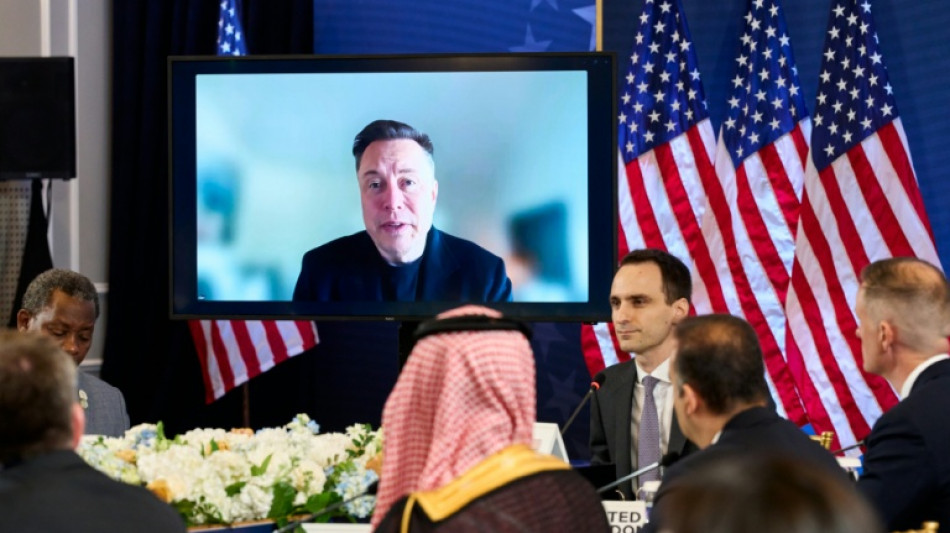
Zuckerberg, Musk make plea at G20 for more AI data centers / Photo: Matt RAMEY - AFP

Mark Zuckerberg and Elon Musk on Tuesday stressed the need for more AI data centers and the electric power needed to support them at a meeting of G20 technology ministers focused on the disruptions and opportunity brought by artificial intelligence.
The US tech bosses spoke virtually at a G20 meeting in Chapel Hill, North Carolina organized by the White House, which is dedicated to keeping the AI revolution largely free of government rules and scrutiny.
The talks came amid a growing backlash against the construction of AI data centers in the United States, a question that has become a major issue as the country heads to midterm elections later this year.
Meta boss Zuckerberg said the buildout would require "hundreds of thousands and maybe millions of jobs" in the skilled trades, "just because the demand for data centers is immense."
"What we've basically found at Meta is that we... can't find the skilled tradespeople that we need to build the data centers... that we as one company are trying to build," he said.
In separate remarks, Tesla and SpaceX chief Musk stressed the massive amounts of electricity needed by the AI data centers, calling out a "crisis of power" in the AI buildout that was giving China the advantage.
"There will be a significant power shortfall next year, not (the) distant future," Musk said, adding that his company was building the required power generation to go with its data centers.
The tech leaders' comments came a day after US President Donald Trump attacked opponents of AI data centers as "backwards and poor."
Polls show a majority of Americans are now against building the centers, amid complaints about rising electricity bills and noise from the facilities.
Musk said he believed artificial intelligence would increase the size of the global economy by 20-30 percent, or roughly $20 trillion to $30 trillion, per year.
In another virtual address to the ministers, Google DeepMind chief Demis Hassabis said the achievement of human-level AI would unleash ten times the impact of the Industrial Revolution.
"It's a huge opportunity that we have to grasp... but we've got to do that in a responsible way," Hassabis said.
The United States holds the rotating G20 presidency this year and is hosting a series of ministerial meetings ahead of a leaders' summit that Trump will convene on December 14-15 at his Trump National Doral resort in Miami.
The Chapel Hill meeting is organized by White House Office of Science and Technology Policy Director Michael Kratsios and Commerce Secretary Howard Lutnick.
Nvidia's Jensen Huang and OpenAI's Sam Altman are expected in person on Wednesday for fireside chats with Lutnick.
Musk in his remarks singled out European governments for what he called overregulation of technology that was stifling their economies.
Technology ministers from EU members France, Italy and Germany were sitting in the room -- as well as EU tech chief Henna Virkkunen.
Innovation needs to be "relatively free of regulation, meaning that new things must be default legal as opposed to default illegal," Musk said.
"In the EU... things are generally default illegal," he added.
"It doesn't ultimately stop it, but it slows it down quite considerably," he said.
L.Mathur--MT