Widow of Iran's last shah says 'no turning back' after protests / Photo: JOEL SAGET - AFP

The widow of Iran's last shah has told AFP there is "no turning back" after a wave of protests against the country's clerical authorities, saying she is convinced the Iranian people will emerge victorious.
Driven into exile with her husband in January 1979 during a popular revolution that brought the Islamic republic to power, Farah Pahlavi said her "desire" and "need today are to return to Iran", in an exclusive interview with AFP.
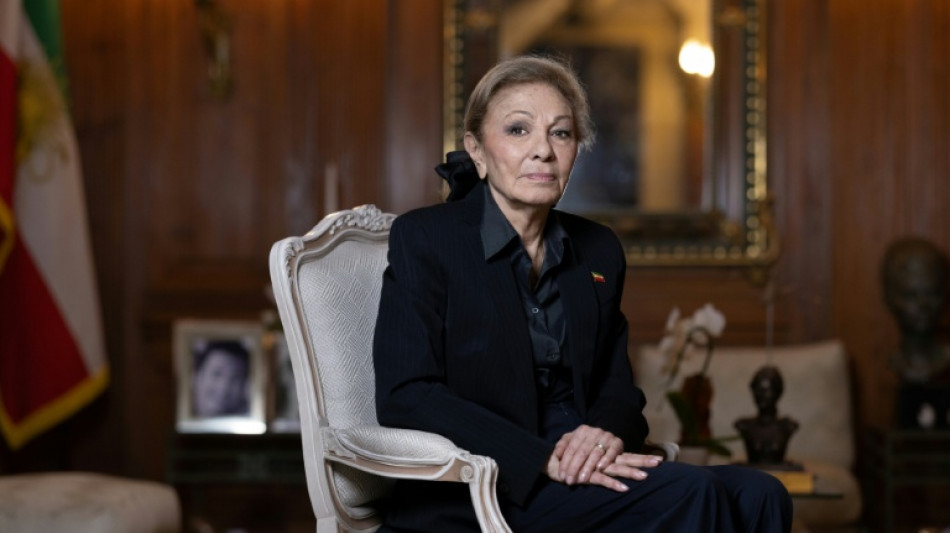
Posing in front of Iran's former flag, emblazoned with a lion and a sun, the 87-year-old former empress, welcomed AFP to her Paris apartment for a photo session after agreeing to answer questions in writing in French about the situation in her homeland.
Triggered on December 28 by smaller protests over economic hardship, nationwide rallies surged in Iran on January 8, challenging the Islamic republic in power for over four decades. The protests were met with a crackdown that rights groups say has left thousands dead.
Question: What message would you like to send to the Iranian people after the recent nationwide protests?
Answer: I want to say to young Iranians: today you are writing, with immense courage, a new chapter of history... for Iran and for the world.
Maintain hope and determination, you will be the victors of this unequal confrontation with the Islamic republic.
To my children, daughters and sons of Iran, to my sisters and brothers -- mothers and fathers of Iran's noble youth -- I extend my admiration.
Q: Do you still have hope despite the suppression of the protests?
A: To date, thousands of these dignified and courageous young people have sacrificed their lives for the freedom of their country. And God alone knows how many more will still fall at the hands of this criminal regime before our Iran once again becomes a free land.
One thing is now certain: there is no turning back. This path is one‑way -- it leads to freedom -- and every day, tragically, it is drenched in the blood of the daughters and sons of this land. Such a sacrifice demands victory.
This victory will not only be that of my country, it will also be that of peace, security and stability in the world.
Q: What is now the role of the opposition, of which you are a part?
A: Opponents of the regime outside Iran today have two essential duties: to ensure a strong link between Iranians inside the country and the peoples and governments of the free world, and to organise ever larger demonstrations to express solidarity with their compatriots, while reminding international opinion of what is really unfolding in a country that is a cradle of civilisation.
Q: Do you want external military intervention in Iran, particularly by the United States?
A: I appeal to the conscience of the entire world, in solidarity with this people, to continue supporting them. Thousands of Iranians must not lose their lives amid general indifference. Strengthening their chances in this profoundly unequal struggle means understanding that with their victory and the advent of a democratic Iran, the region will move towards a more peaceful Middle East.
Q: If the clerical leadership were to fall, what role do you see for your son Reza Pahlavi?
A: His role will be exactly the one with which the Iranian people decide to entrust to him. My son, whose name is chanted at every demonstration, has always stated throughout his public life that it is the Iranian people who will freely decide the future of their country. He himself sees his role solely as the mouthpiece of young Iranians until the day of freedom.
Q: In that case, would you return to Iran?
A: For 47 years I have wished for, and waited for, Iran's freedom. The Iranian people, with deep affection, call me the mother of Iran. In times of trial, every mother and every child need to be together. My desire and my need today are to return to Iran and to hold these exceptional children in my arms.
Like any mother separated from her children, I feel, deep within me, that this journey and this reunion will take place soon.
E.Bansal--MT