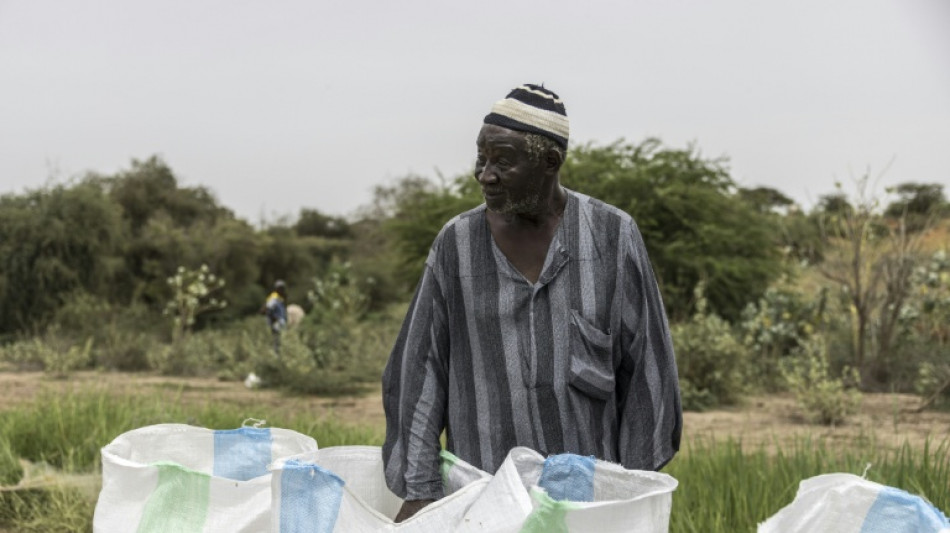
Just add fish: Scientists pursue more rice, less disease in Senegal paddies / Photo: PATRICK MEINHARDT - AFP

Half smiling through crinkled eyes, Moussa Ndiaye, in his long tunic and skull cap, watched a combine harvest his northern Senegal rice paddy, where he expects a good haul, but not just of grain.
His field is part of a study which aims to fight one of the world's major parasitic diseases and increase rice yield by adding fish into paddies, which can then be caught and sold for profit: a rare win-win-win for local farmers.
In Senegal, rice and fish are ubiquitous dietary staples and practically a matter of national pride, so growing the two side-by-side is logical, those involved say.
Such nature-based solutions are part of a growing trend in science, and so far, the results have been promising: In the pioneering study, fish eat snails that cause the parasitic disease schistosomiasis, while also fertilising the rice with their poop.
Ndiaye's village, Lampsar, is in the lower Senegal River valley, near the border with Mauritania, where people have long lived off the waterway's fish.
But they are not traditionally kept in rice paddies.
"Since our youngest age, since our grandparents, we have fished. We're Waalo-Waalo," said the 80-year-old, referring to an ancient kingdom by which people in the region still identify.
In addition to fish, the area is known for schistosomiasis caused by parasites released by freshwater snails, which are common in the paddies.
Ndiaye has had the disease three times and his sons who worked in his fields also contracted it.
It can cause symptoms ranging from itchy skin to organ damage or even death and can be treated with medicine.
But that doesn't prevent reinfection or mitigate the time and money lost from missed school or work.
While deaths are difficult to calculate, the World Health Organization estimates that 254 million people require preventative treatment and that 94 percent of those needing treatment live in Africa.
Transmission of the disease has been reported in 79 countries, it says.
- 'Consistently greener' -
Scientists introduced Nile tilapia, which fertilise the fields, and African bonytongue, which eat schistosomiasis-causing snails, into the paddies.
More than 40 farmers across multiple villages participated in a pilot study and follow-up research.
"It's not just a one-hit punch, we're really tackling a lot of challenges," said Emily Selland of the University of Notre Dame, lead author of a paper on the pilot study published in the journal Nature Sustainability.
"We came at this from the disease angle first," she told AFP, but then there was "the nutrition angle, the economic angle, the sustainability and ecological angle".
Her research found that adding the fish boosted rice yields by 25 percent, with an average net benefit to rice farming households of at least $380 per year.
And fewer snails were found in the fields with the predator fish.
Lampsar has several thousand inhabitants, who live in typical low-slung cinderblock compounds.
Speaking to AFP from a neighbour's house where farmers gathered in the afternoon heat, Abdoulaye Diop said he had "noticed that fields containing fish are consistently greener than those without them".
The 62-year-old said he had used the profit from his fish to invest in sheep and poultry.
In total, Ndiaye harvested 20 sacks of rice, each weighing 80 kilogrammes (175 pounds), the day AFP visited, with half a dozen young men scrambling to fill the bags as rice poured from the combine.
Several days later, he harvested more than 350 large tilapia and three African bonytongue, known as ndieguel in the local Wolof language, from his field.
Mai Diop, who comes from generations of rice farmers, told AFP next to her verdant paddy that she participated "to earn more income".
Like many Senegalese, she eats rice at least once a day and said her favourite meal was thieboudienne, the country's emblematic national dish of rice and fish.
- Ready to scale -
At an aquaculture facility at Gaston Berger University (UGB) in the city of Saint-Louis some 15 minutes southwest of Lampsar, Nile tilapia rippled the water's surface in a large concrete basin.
The fish will soon head to research paddies belonging to AfricaRice, a centre that will conduct similar studies but in a controlled environment.
The idea is to hone the process and gain more data before scaling up.
"When you conduct an experiment in a rural setting with farmers directly, there are many parameters you can't control," Ali Ibrahim, regional representative of AfricaRice's Sahel Station, told AFP.
AfricaRice's results should be even stronger "because we're going to have fixed points where we know how many snails started there", said Kayla Kauffman, of Stanford University's Disease Ecology in a Changing World programme, which is also involved.
At UGB, several tubs of snails awaited their placement in the research paddies.
The work is not yet underway, but the scientists are optimistic.
"Our intention is that, once we have the expected results, this be scaled up across many African countries," Ibrahim said.
N.Prakash--MT