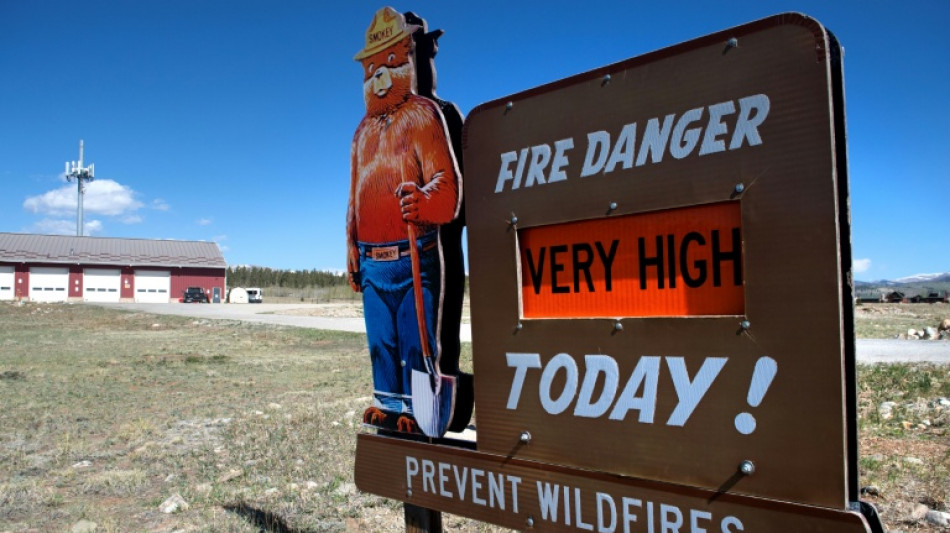
With record-low snow, Colorado preps for wildfire onslaught / Photo: Jason Connolly - AFP

Larry Graves pulled up to a home tucked into a Colorado mountainside. His radio was crackling, as was the wildfire burning beyond the trees -- it was time to move.
"You guys hear about the mandatory evacuation?" the Ouray County sheriff's deputy asked resident Amy Clewell.
But this was just a drill. Emergency responders in Ouray County were training -- on a large scale for the first time -- for this year's wildfire season that is predicted to be one of the worst ever in the American West.
States from Arizona to Wyoming rely on Rocky Mountain snowfall for their water supply. But the region had record-breaking high temperatures last winter, causing historically low levels of snowpack.
The result: parched soil and vegetation -- ideal conditions for wildfires.
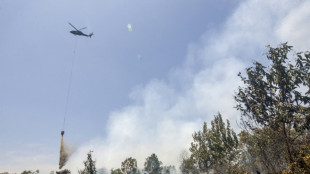
Twenty-seven minutes after Graves's visit, an ambulance arrived to pick up Jordan Wyatt and Jennifer Shook, who were portraying injured victims. A short distance away, firefighters hosed water onto an imaginary blaze.
Shook, who uses a wheelchair and works for an organization supporting people with disabilities, volunteered for the mock rescue after her mother last summer was unable to access updates from authorities as a wind-whipped wildfire quickly cut off roads near her home.
"Watching her stress level and knowing that we have other people with disabilities that would need to be evacuated, I wanted to participate," she said.
- 'Never seen anything like it' -
This type of drill, increasingly common in Colorado, is essential for identifying coordination gaps among emergency responders.
They also help residents prepare for the nerve-wracking scenario of an evacuation.
"I've worked here my whole life and I've never seen anything like" this year, said Aaron Jonke, fire chief in the small town of Salida.
"The moisture is way down, so it's a much more dangerous situation," he said, adding that he'd been warning residents about fire risk since January.
"With climate change, the fire season changed from a summer event to a year-long event."
Jonke spoke to AFP at Colorado Fire Camp, a training facility where participants on a recent day were learning to use chainsaws, an essential tool for creating firebreaks in forests.
Daniel Pusher planned to bring his new skills home to his White Mountain Apache Tribe in eastern Arizona to carry out a tree-thinning project.
Reducing overgrowth mitigates fire risk while improving the overall ecosystem and water quality, he said, adding that the drought has made his community extra vigilant, to "take care of our land."
Eight of the region's 11 states recorded their lowest-ever levels of snowpack this past winter. Colorado, one of the eight, activated its drought plan in March.
- Marmots and flowers -
Home to some of the world's top ski destinations, Colorado has seen its landscape become unrecognizable by the drought.
At Loveland Pass, with an altitude of 3,650 meters (11,975 feet), Tim Faris was surveying grassy slopes with skis in hand, looking for a patch of snow to carve.
"Usually I can ski until the end of June," he said. "Now I'm hiking past marmots and flowers to get to where I can find some snow."
Down in the valley, the docks at a small marina on the Dillon Reservoir sat on a bed of mud, with water levels six meters below normal.
The Antero Reservoir, a popular fishing spot, was blocked by a padlocked gate.
"No recreation due to low water levels," a sign said.
The drought has further exacerbated long-running conflicts over the distribution of water from the Colorado River, which provides drinking water for 40 million people and irrigates farms throughout the region.
In Colorado's capital city Denver, authorities transferred water from one reservoir to another, to reduce the amount that will be lost to evaporation.
Approximately 90 percent of the city's water comes from melting snow, and the trend is clear: average snowpack levels are dropping year after year, Denver Water official Nathan Elder said.
In Ouray County, once "victims" like Shook had been whisked to safety and fire hoses rolled back up, the roughly 175 emergency workers and volunteers gathered in a community hall to debrief.
The emergency cellular network had not functioned well, nor had the fire department's new radio system.
Volunteer Diane Moore gained valuable lessons from the drill: keep a "go bag" packed and ready in case of evacuation -- and be sure to include a phone charger.
"We're going to go home and get one ready," she said as she left.
Q.Dutta--MT