Nepal floods among 'most challenging' disasters: WFP / Photo: PRABIN RANABHAT - AFP/File

Aid operations after Nepal's devastating floods rank among the World Food Programme's most challenging, its country chief said Thursday, as cargo drones and helicopters delivered food to isolated communities.
The catastrophic August 26 flood was triggered by a Himalayan glacial mountain collapse on the China-Nepal border, that scientists have linked to climate change.
The tsunmai-like floodwaters tore through mountain districts, destroying roads, bridges and hydropower dams, and killed at least 1,446 people. More than 6,500 remain missing across both countries.
Riaz Lodhi, head of the UN's World Food Programme (WFP) in Nepal, told AFP that it was among the "top three most challenging disasters" the agency had faced.
"We have seen disasters, we have seen earthquakes, we have seen disasters caused by floods, we have seen war situations, conflicts," Lodhi said, speaking at the aid hub in the capital Kathmandu.
"We have had access challenges in many of these situations", he added, but said the challenges in Nepal were extreme.
"This is a very unique access challenge where, in some places, the only way to reach people is by helicopters," he said.
"It's a very, very expensive operation."
The destruction meant journeys that once took two hours can now have become day-long ordeals.
Many communities near the epicentre of the disaster remain cut off, with the UN working alongside Nepal's government to get emergency supplies into devastated areas.
- 'Game-changer' -
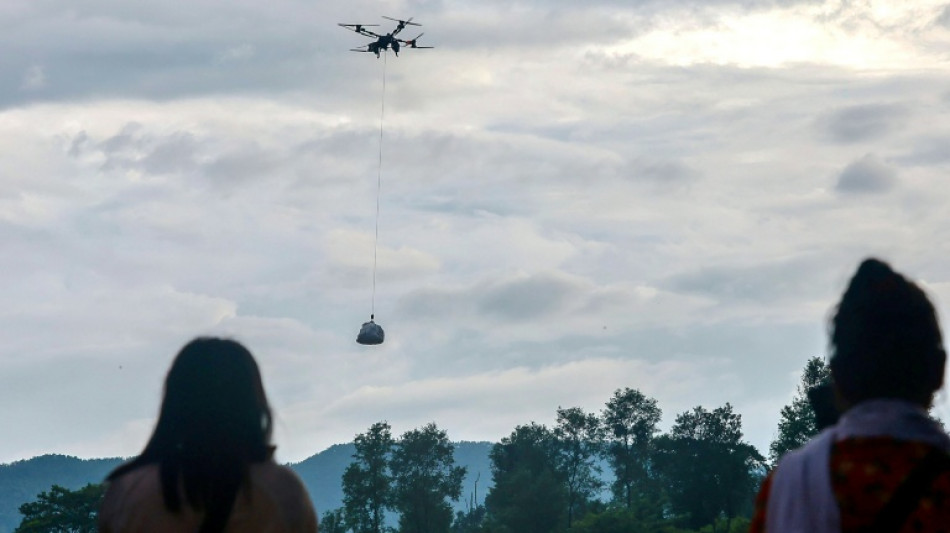
For the first time in Nepal, WFP deployed cargo drones to deliver food to isolated communities.
"When the first drone went up in the air with the food attached to it, I knew that it was a game-changer... It's an innovation in delivering food assistance," Lhodi said.
During a deadly 2015 earthquake in Nepal, WFP relied on mules, yaks and porters carrying food on their back, sometimes taking two to three days to reach those in need.
"Now, the same food, by deploying these cargo drones, we were able to deliver within five to 10 minutes," Lodhi said.
The drones can carry between 30 and 100 kilograms (66-220 pounds), depending on operating conditions.
"People in need, they didn't have to wait for days," he added. "The food was reaching there immediately."
Lodhi said that WFP has used drones before, but not at this scale.
"What we are learning in Nepal with the use of these cargo drones will change the way WFP reaches people in need," he said.
WFP expects to provide food assistance for four to six months, but Lodhi said that would not mean the end of humanitarian needs.
"They have lost their food stocks, they have lost their homes, they have lost their crops. So the needs are huge," he said.
The sheer scale of the flood was unlike anything witnesses had seen before, with the Nepali government pointing the finger at the dire impact of rising global temperatures on the Himalayan mountains.
Prime Minister Balendra Shah will take his first foreign trip as Nepal's leader to address the UN General Assembly on the urgent issue next week.
Nepal estimates the reconstruction bill will amount to $4.78 billion.
X.Kapoor--MT