Review: Joe Hill-Gibbins' 'Julius Caesar' at The Sam Wanamaker Playhouse

Joe Hill-Gibbins’ production of Shakespeare’s ‘Julius Caesar’ opens with dramatic drumming and animalistic howling at The Sam Wanamaker Playhouse. Katie Kelly reports that this pared-back version focuses on power and treachery, utilizing the intimate Jacobean replica theatre to create a tense, immersive atmosphere through candlelight and sound.
Joe Hill-Gibbins’ production of Shakespeare’s ‘Julius Caesar’ at The Sam Wanamaker Playhouse begins with an arresting sequence of dramatic drumming and animalistic howling. In a review for the publication, Katie Kelly describes this opening as setting the tone for a pared-back interpretation that concentrates on themes of power and treachery within the intimate confines of the Jacobean replica theatre.
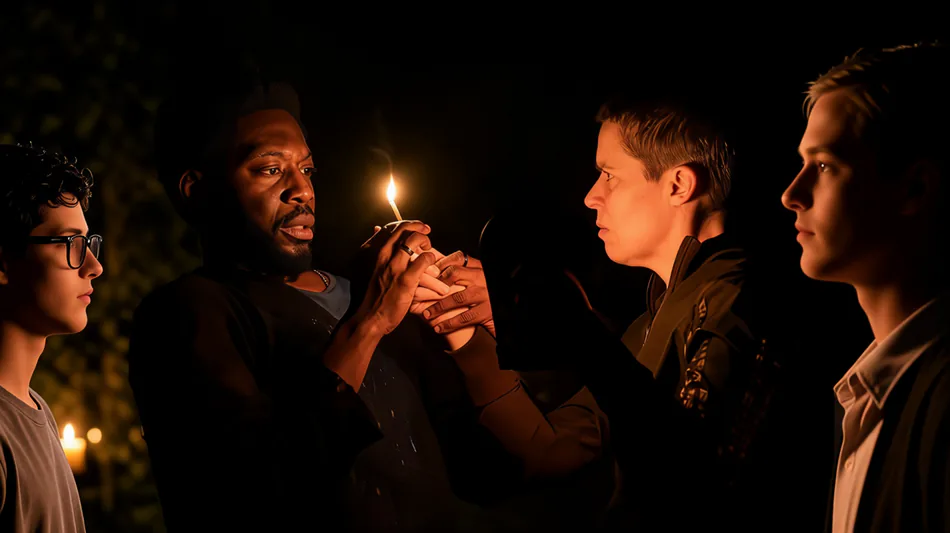
The staging is identified as a central highlight of the production. The use of candlelight, appropriate for an authentic Jacobean venue, establishes an air of threat and gloom. Characters hold handheld candles to illuminate themselves and one another, casting amplified shadows against a huge bronze disc that serves as both backdrop and occasional percussive instrument. Sound design permeates the performance, with drumming rising and falling to reflect and create tension, adding significantly to the atmosphere.
The production features only four characters: Caesar, Brutus, Cassius, and Mark Antony. Keeping all four actors on stage at all times is noted as effective, particularly when Caesar looms on the edges of the stage while the others conspire against him. While the core plot survives this abridgement reasonably intact, Kelly suggests that the psychological underpinning of the action may be lost. The storytelling remains clear, but the motives of the conspirators become less so, leading to confusion as the play progresses.
Following Caesar’s murder, chaos is represented by bodies writhing together as they move toward their own destruction. Performances are described as subtle, with Caoilfhionn Dunne playing Brutus with wry restraint and Kate Duchenne portraying Caesar convincingly imperiously, except during a scene where she vomits up the prophecies of the soothsayer.
The review notes that while the actors utilize the possibilities of an intimate space, the relationship between their characters is underdeveloped. Dunne’s Brutus does not appear particularly conflicted by murdering his former friend, causing Caesar’s death to lack emotional effect and rendering the pathos of “Et tu, Brute?” flat.
In contrast, Natey Jones’s Cassius is described as rather too shouty, with his relentless intensity at times feeling like sound and fury signifying not enough. Adam Gillen makes an impressive entrance as Mark Antony but appears somewhat unhinged at times, moving in animalistic ways that occasionally reminded the reviewer of Gollum. It is unclear if this was intentional. When he recruits the audience as the mob, the effect is described as more comic than sinister.
The overall experience of the production is characterized as intense, immersive, and engaging of the senses, though perhaps not the soul. Booking details are available at ShakespearesGlobe.com.
F.Patel--MT