Power, water, jobs: Google on India data centre concerns / Photo: Idrees MOHAMMED - AFP

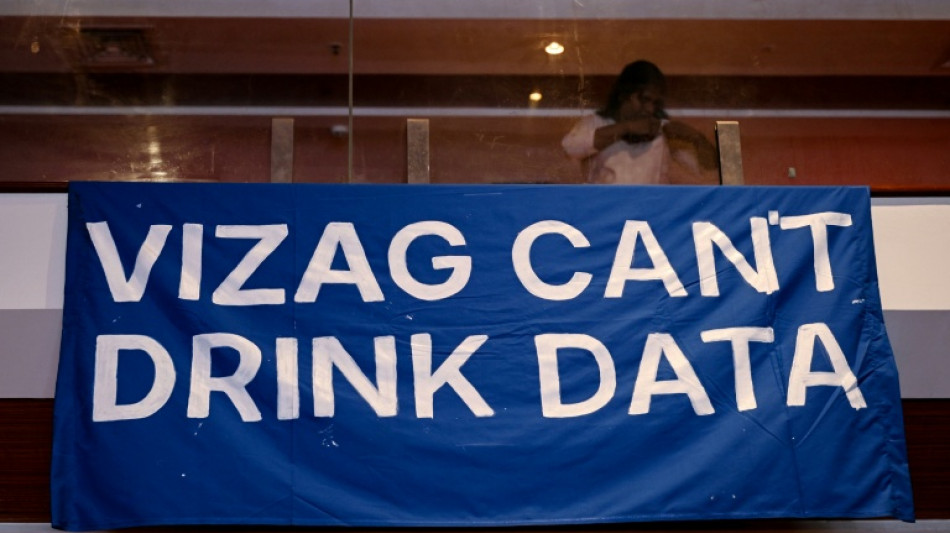
Construction of a massive Google data centre in the Indian city of Visakhapatnam has been met with resistance from residents who fear the impact on the environment and their lives.
But the tech giant says its "gigawatt-scale" AI facility in southern Andhra Pradesh state -- part of a $15 billion investment -- will use air cooling systems, and not water from an area already facing shortages.
Alexander Smith, Google's head of infrastructure and energy for the Asia-Pacific region, answered AFP's questions about the project:
- How do you view the concerns? -
Smith said Google takes questions raised by the public seriously.
"Independent environmental assessments -- covering grid stability, power supply, water risk, ecology, acoustics and more -- are conducted 12 to 24 months before a project begins," he said.
"If there is insufficient power in a location, or if operating a data centre would mean taking power away from a community, Google will either find ways to develop more power, or it will not build there."
The data centre -- Google's biggest "AI hub" outside the United States -- is set to become operational in 2028.
It is one of several huge new tech sites planned in Visakhapatnam, but activists are demanding a moratorium on new data centres across Andhra Pradesh until there is more evidence of their impact on the environment and local community.
Smith called the project "a multi-decade commitment" that carries "an obligation to be a good neighbour".
"That means the watershed, the grid and the communities around our facilities must be better off for our being here."
- What are its water and power needs? -
As AI use accelerates, construction of power-hungry data centres is booming worldwide, especially in Asia.
Critics say they will add demand to electricity grids still heavily reliant on planet-warming fossil fuels, and place new pressure on often-stretched local water supplies to cool down hot servers.
Google's water assessment for Visakhapatnam "pointed to pressure on the local watershed", Smith said.
"That finding shaped our choice of cooling configuration from the outset," with "advanced air cooling" chosen instead of water cooling.
"For the freshwater consumed by non-cooling facility needs, Google is committed to replenishing 120 percent of the volume we consume across our operations by 2030," he added.
Google does not disclose site-level capacity figures for power.
But the US giant "fully funds the cost of required power infrastructure upgrades".
"We are planning to invest in new clean energy projects -- built above and beyond what regulations require -- in Visakhapatnam," Smith said.
- Why did Google choose Visakhapatnam? -
A Finnish authority recently ordered work to halt on two Google data centre sites pending mandatory environmental assessments, and worried residents have also mounted protests in Visakhapatnam.
To select global sites, Google looks for "proximity to customers and users, access to talent, potential for new clean energy and opportunities to establish mutually beneficial partnerships with local communities", Smith said.
"Visakhapatnam is one of the few places where all of these come together."
The city's coastline also allows undersea cables to link Visakhapatnam to South Africa and Australia, "positioning Andhra Pradesh as India's third major subsea hub", Smith said.
- Will promised jobs benefit people? -
Data centre opponents say the benefits of the vast warehouse-like sites rarely trickle down to local residents.
Smith said that "a development of this kind is projected to generate approximately $688 million in local economic activity every year".
"For every job inside a Google data centre we support nine additional jobs in the surrounding community," he added.
"Over a typical three-to-five-year construction period, an average Google data centre development employs about 4,200 construction workers annually."
"Each facility is designed to operate for at least 20 years, and once live it sustains hundreds of specialist on-site roles," he added.
X.Ranganathan--MT