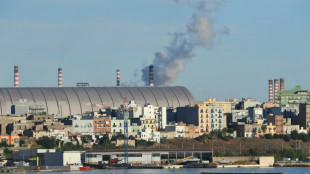
The reality of restarting North Sea oil drilling / Photo: ANDY BUCHANAN, ANDY BUCHANAN - AFP/File

As the Middle East war drives up oil prices, the UK's main opposition Conservative party is urging the government to restart drilling in the North Sea -- echoing repeated calls from US President Donald Trump.
Experts warn, however, that the proposal runs up against geological and economic realities.
- Why call for North Sea drilling? -
The Conservatives, who are heavily outnumbered in parliament, are preparing legislation aimed at removing barriers to oil and gas drilling in the North Sea, in order to facilitate access to domestic fossil fuel resources.
They echo Trump's repeated criticism of Britain's Labour government for failing to sufficiently exploit offshore reserves, even as the UK faces some of the highest energy prices in Europe.
"Go get your own oil!" Trump again urged on Tuesday in a post on Truth Social, without explicitly naming any country.
"Drilling in the North Sea and expanding other sources of generation" is the "only way we can protect families from rising bills, keep the cost of energy down for business, and control inflation," Conservative leader Kemi Badenoch wrote in a blog post.
The Labour government, meanwhile, has pledged to halt new exploration licences in the North Sea for environmental reasons, although it slightly softened its policy in November.
- What would be the impact? -
While supporters argue that restarting drilling would strengthen security and energy independence, experts interviewed by AFP emphasised major constraints for both oil and gas.
The area that "the UK has access to is a very mature, depleted basin," Tessa Khan, an environmental lawyer, told AFP.
"The productivity of that -- in terms of how much you could extract from it -- peaked in the late 1990s and it's been in decline ever since," she added.
Structural limits also apply, as production cannot immediately be redirected to domestic consumption.
"The UK is part of oil and gas international markets, and we have to remain part of these markets because we need to import," said Simon Cran-McGreehin, an analyst at the Energy and Climate Intelligence Unit, a non-profit research group.
Prices are set on these markets according to supply and demand, and the UK's low level of production has little, if any, impact on them.
"Bringing in new production takes years, which means that any new oil and gas would arrive long after the crisis has passed," the UK Energy Research Centre said in a recent briefing.
- What are the other solutions? -
The quest for energy independence has returned to the forefront since the start of the Middle East war, as it did after Russia invaded Ukraine in 2022, which sent gas prices soaring.
Two options are often put forward by experts: reducing fossil fuel consumption and significantly expanding renewables.
"The UK has one of the biggest offshore wind markets in the world," Khan said.
"We already have a backlog of renewable energy projects that are waiting for grid connections," and the timelines are potentially "much shorter" than for fossil fuel projects.
Renewables also offer stronger job creation prospects.
According to a study by Robert Gordon University in Aberdeen released last year, the workforce in the oil and gas sector could be cut in half by the early 2030s, while jobs in renewables are projected to nearly triple by 2035.
A.Singh--MT