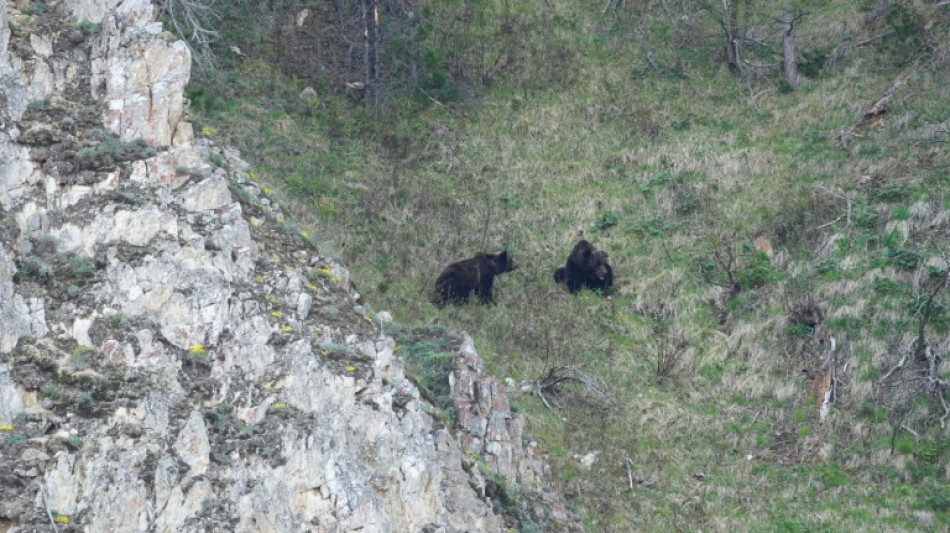
'We've never had this': Bear sightings spook Russia / Photo: Handout - National Park "Zapovednoye Pribaikalye"/AFP

Seeing what looked like a brown blob in a tree while driving through Siberia's Irkutsk region, 36-year-old Daria Tyurneva pulled over, curious to get a better look.
She was not expecting to find a bear cub, perched on a branch, several feet up.
"We stopped, without turning off the engine or taking off the gear, because we knew the mother could be somewhere nearby," Tyurneva told AFP, showing a phone video she recorded of the bear.
Her sighting was one of several to spook Russians in recent weeks, as the country grapples with a spate of deadly bear attacks.
Russia is home to the world's largest population of brown bears. Experts say interactions with bears are becoming more common, as habitat loss and climate change force the animals to find food where humans live.
Their numbers have more than doubled since 1990, from around 130,000 to almost 308,000 in 2026, according to an estimate from Russia's natural resources ministry.
While the number of bear attacks across Russia has remained constant at around 20 to 30 a year, according to the ministry, a series of recent maulings has caused alarm.
At least 26 people have been killed in bear attacks this year, seven of which were in Siberia's vast Krasnodar region, according to Russian state media.
In September, a bear was reported to have killed a 66-year-old woman after dragging her from her window, while a week later, a 39-year-old logger was killed guarding machinery in a forest.
A Siberian town reported last month that it was "under siege" from the furry animals.
- 'I started fighting it' -
Bears flee in the vast majority of encounters with humans, according to the Russian government.
The number of deadly attacks this year has not yet reached the record of around 80 deaths, last seen in 1996, according to the state-owned TASS news agency.
This year has seen abnormally large bear sightings, said Mikhail Strelkov, a ranger in the Lake Baikal national park.
"We've never had this," he told AFP of the recent incursions of bears into urban areas.
"There is no pine nut in the forest, the main food source that the bear eats and uses to fatten before hibernation," he added.
He showed AFP videos his team had recorded of bears frolicking at the edge of Lake Baikal, one of which scampered away upon hearing their boat approach.
Vladimir Odulo, an angler from Russia's far east, told the Komsomolskaya Pravda newspaper in October how a female bear rushed at him on the banks of a river.
"Believe it or not, I didn't even have time to get scared. I started fighting it off with my fishing rod," he said.
He said he escaped after a fight that left him with injuries across his body.
- 'Not afraid of bears' -
Authorities have introduced curfews in some municipalities and formed bands of hunters but some environmental activists say the government may be overestimating the bear population.
So far, in 2026, officials have culled more than "3,400 dangerous bears", TASS reported earlier in October.
Alla, a Russian tourist whom AFP met at the entrance to a hiking trail near Lake Baikal, said she turned back after seeing a sign warning of bears.
"Maybe I will come again to see. Maybe in summer, maybe in winter, when they're hibernating," she said.
Other tourists were unfazed.
"I'm not afraid of bears," said 39-year-old Chinese tourist Nick, who also only gave one name.
Brown bears eat a mixed diet that can include up to 90 percent fruit and vegetation.
Russia's emergencies ministry says the best way to avoid bear encounters is to make loud noises and that in the rare event a bear starts to attack, "to give up".
"It's common for a bear to stop attacking when it feels the threat has been eliminated. Remain motionless for as long as possible," it said.
"If you move and the bear sees or hears you, it may return and resume the attack. In rare cases, an attacking bear may mistake a person for food."
H.Anand--MT