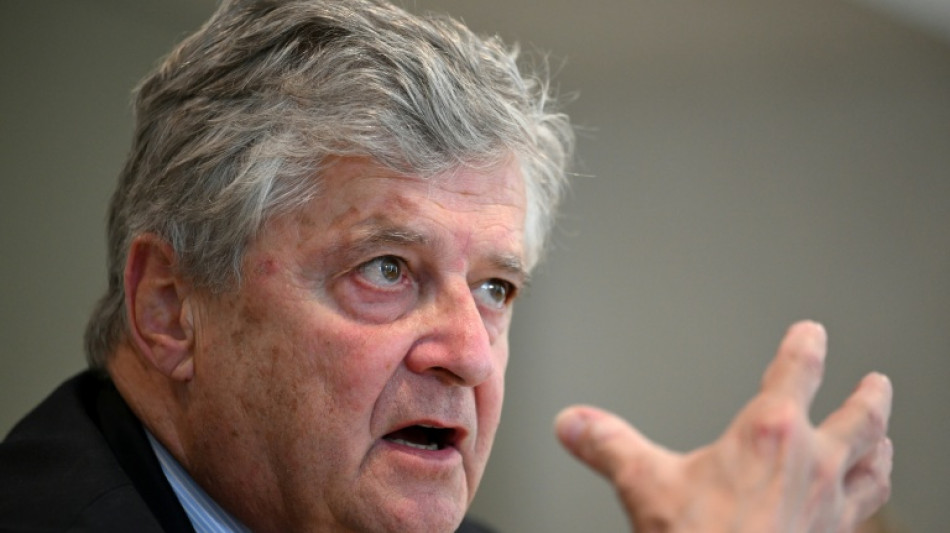
France must avoid becoming 'hostage' on critical minerals: trade minister / Photo: Saeed KHAN - AFP

France and "like-minded countries" must work together to avoid becoming "hostages" on critical minerals used in everything from phones to solar panels, Paris's trade minister said Thursday.
Speaking in Sydney, Nicolas Forissier told journalists that France was working to expand cooperation with Australia -- among the world's top five producers of lithium, cobalt and manganese, essential for goods like rechargeable batteries and aircraft jet engines.
He said democratic nations needed to avoid a situation in which critical minerals "could be weaponised again in this very uncertain and violent trade and economic world".
"We have to organise things so that it's secure," he said.
China dominates the production of rare earths and has threatened to restrict supplies in a tit-for-tat trade war with Washington -- leaving Western nations looking elsewhere.
"What is important is to build something which will last," Forissier said.
"The idea is to find solutions that secure the system and that avoid us, I mean, all our like-minded countries, not to be hostages in the future."
Critical minerals were also a key component of a landmark trade deal between the EU and Australia agreed to last month.
The agreement aims to give Europe better access to these materials, most notably aluminium, lithium and manganese.
The sweeping accord also means the quota of Australian beef allowed into the bloc will increase more than 10 times the current level over the next decade.
That upset both Australian farmers, who had hoped for more, and their European peers, who had pushed for the opposite.
Asked about domestic concerns around the deal, Forissier said that complaints from farmers in both France and Australia proved the agreement was "balanced".
"For French exporters, especially in certain agro sectors, it's an excellent deal that has been made," he said.
"The discussion has been settled," he added.
"We can say that we obtained as much as possible in the discussions."
"When you have a trade agreement, everybody makes concessions."
X.Kapoor--MT