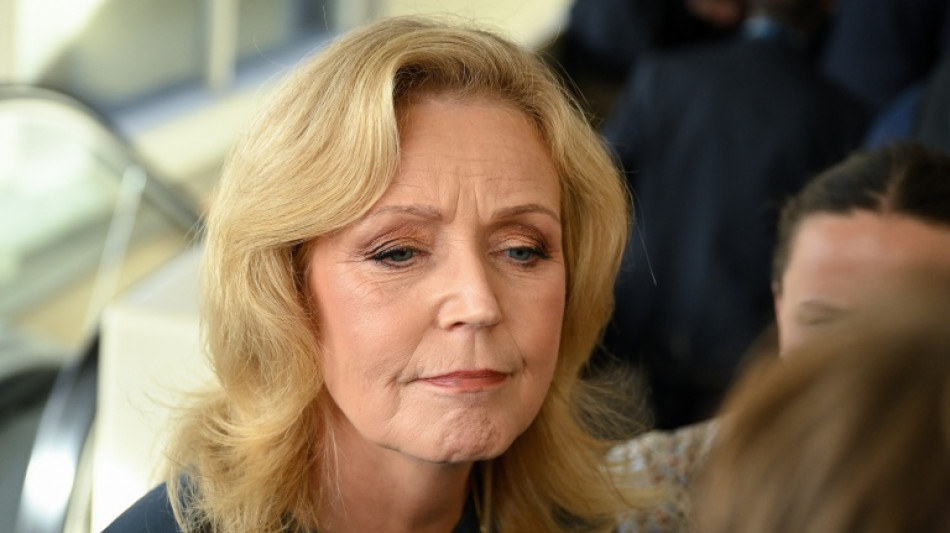
Swedish Centre Party leader says government coalition talks failed / Photo: Jonathan Nackstrand - AFP
Swedish Centre Party leader Elisabeth Thand Ringqvist on Monday said she had failed to form a government uniting left and right wing parties, leaving the Nordic country no closer to a new government after its September 13 election.
"My overall conclusion is that there is currently a majority in favour of centrist policies, but no majority for a centrist government," Thand Ringqvist told a press conference.
Parliament speaker Andreas Norlen announced shortly after that he would speak with party leaders and then provide an update on next steps. He did not specify a timeframe.
Sweden's opposition left-wing bloc won a three-seat majority over the right-wing bloc headed by outgoing prime minister Ulf Kristersson in the election, but opposition leader Magdalena Andersson twice gave up attempts to build a left-wing government.
Kristersson currently leads a caretaker government.
With neither the left nor the right wing parties able to build a majority, Norlen tasked Thand Ringqvist to explore the conditions for a "middle option".
Thand Ringqvist had floated the idea of a government "in the middle" that would include mainstream parties but exclude the socialist Left Party and the anti-immigration Sweden Democrats.
The Centre Party has refused to collaborate with the Sweden Democrats, making it near-impossible for the right-wing bloc to obtain a majority in parliament.
On the left, the Centre has refused to support a government that includes the Left Party.
The speaker has four attempts to propose a prime minister candidate for a vote in parliament. If the fourth attempt fails, a snap election must be called.
A first attempt failed on October 15, when Social Democratic party leader Andersson did not win the support of lawmakers in a vote. The speaker can also ask candidates to probe conditions without putting them to a vote.
Political experts have predicted that the parties will feel increasing pressure to compromise on their political "red lines" the closer they get to the risk of a new election.
The Scandinavian country is accustomed to lengthy negotiations on governments. It took 37 days after the 2022 election and 134 days in 2018.
jll/tw
A.Singh--MT