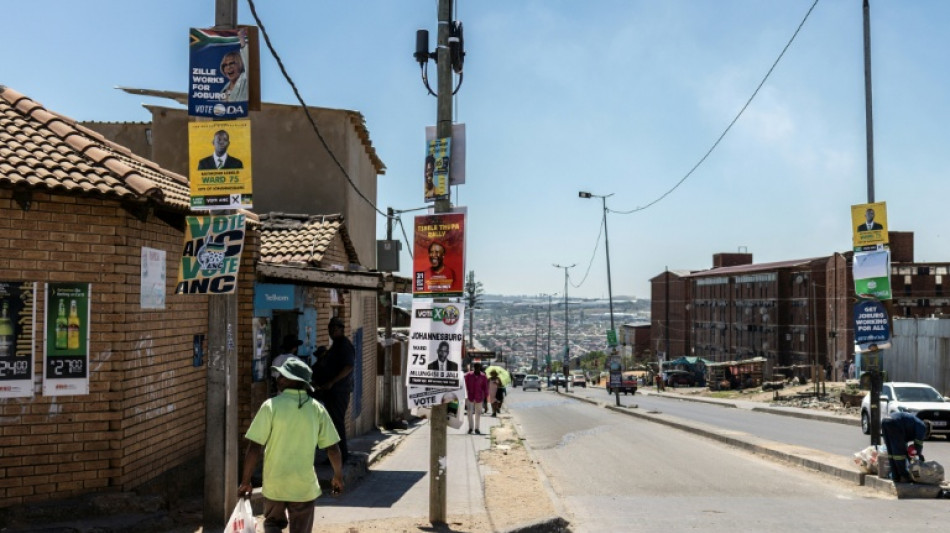
Basic services, fading loyalties loom over South Africa's vote / Photo: ILARIA FINIZIO - AFP
Ntombekhaya Makeleni stopped using the communal toilets in her Cape Town neighbourhood after a group of men tried to force their way in as she was inside one day before dawn.
Now the 53-year-old relies on a bucket that is emptied outside later, as do many others in the deprived township of Khayelitsha where thousands live in informal shacks with no sanitation.
The lack of a decent toilet is pushing Makeleni to the polls in South Africa's local government elections next week. "I will be voting because after voting, things will be fixed," she told AFP.
The November 4 poll promises a glimpse into whether frustrations with local government failures are changing political loyalties -- including for the once long-dominant African National Congress (ANC) -- ahead of the 2029 general election.
A lack of basic services such as water and power, crumbling infrastructure and high unemployment are high among the concerns of more than 29 million people registered to vote.
In the east coast city of Durban, 27-year-old Nikesh Nunkoo said water cuts in his neighbourhood of Shallcross could last anywhere from three days to two weeks.
Having voted in three previous elections, he was still weighing whether to cast a ballot this time. "I don't have any hope that things would be better in the next five years," he said.
Nkanyiso Hadebe, 24, who lives in an informal settlement in the city's Chatsworth area, was clear. "I will not vote because voting changes nothing," he said.
More than 500 parties are registered with the electoral commission, reflecting a political landscape that has become increasingly fragmented as support for traditional powerhouses, such as the ANC of late anti-apartheid icon Nelson Mandela, has eroded.
An Ipsos survey published in March found nearly half of South Africans felt no political party represented their views, while only 38 percent believed their municipality was doing its job well.
- 'A shame' -
For the first time since democracy in 1994, the ANC slid under the symbolic 50-percent threshold in 2021's local elections. It lost its national parliamentary majority in 2024.
The second-largest party, the liberal Democratic Alliance (DA), governs Cape Town and has run a determined campaign for Johannesburg, playing up the failures of the ANC-led council running the economic hub.
But in Cape Town itself, the contrast between affluent suburbs and poorer townships remains stark three decades after the end of apartheid.
"Residents, especially in townships, are not asking for much. They want basic services," political commentator Kuhle Zwakala of Stellenbosch University said.
"To be talking about electricity, water and sanitation issues 30 years into democracy is a shame."
Not all voters will be swayed by service delivery issues, said Oscar van Heerden, a senior research fellow at the Centre for African Diplomacy and Leadership.
"There is also an identity factor," he told AFP, noting enduring support for the ANC in historically black townships and for the DA among the white electorate.
A newcomer to local government elections is ex-president Jacob Zuma's MK party, which secured third place in the previous national polls.
For some younger South Africans without liberation-era loyalties and most affected by the 33 percent unemployment rate, voting seems pointless.
Ntokozo Mthethwa, a 21-year-old IT student from Durban's Umlazi township, doubted any party could deliver on its promises. "I see no future for me here," he said.
- Coalitions -
Voter turnout will be a key factor on Wednesday: only 46 percent of registered voters cast ballots in the 2021 local elections, compared with 58.6 percent in the 2024 polls.
The results, which are due from Sunday, are likely to reinforce the trend towards coalition governments and test whether they can produce stable local councils.
Since the last municipal elections, no party was able to hold a majority in just under a third of the 257 councils, according to research by the Mapungubwe Institute for Strategic Reflection.
By February 2026, 74 municipalities were governed by coalitions or minority administrations, it said.
strs/ho/br/sbk
J.Gill--MT