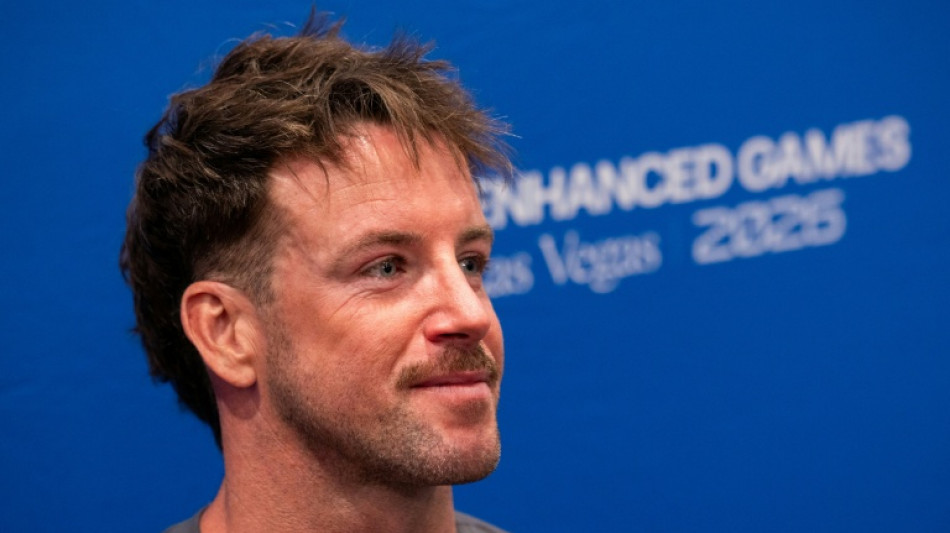
Enhanced Games athletes under scrutiny as health fears swirl / Photo: ETIENNE LAURENT - AFP

The drug-fueled Enhanced Games have put competing athletes under scrutiny, with critics asking why they signed up for a pro-doping competition that is potentially dangerous for their health, and to young viewers who could be tempted to emulate them.
Asked for their motivations ahead of this weekend's Las Vegas multi-sport event, the responses ranged from the spikily defiant to the purely mercenary -- with a smattering of caution.
Retired Australian Olympic swimmer James Magnussen, who confirmed he has taken five banned substances from a list including testosterone, peptides and anabolic steroids, said he was not concerned because use of the drugs was already rife among friends back home.
"I have to try and convince my friends back in Australia to dial down the amount of peptides or enhancements they're taking," he joked.
But when questioned if he was worried that children or teenagers might watch the Games, or Instagram posts showing his impossibly ripped physique, and order supplements themselves, Magnussen said the question was hypocritical.
"When I turn on TV here in America, I see ads for every pharmaceutical brand I could imagine, I see ads for gambling, I see ads for alcohol," he said.
"None of those things are for child consumption. So it is up to the parent and the role model to differentiate for the child what is for their consumption and what is not."
For former 100m world champion Fred Kerley, who is competing without drugs in the Enhanced Games, the question of athletes' responsibility for peddling experimental drugs to the public was swatted away more directly.
"It's a business at the end of the day... you got to sell to somebody," he told AFP.
"I've got shares in the company. So more power to them," added Kerley.
The Enhanced Games are being bankrolled by billionaire Peter Thiel, Donald Trump Jr., and Saudi royalty, among others.
Not every athlete at the Enhanced Games was as defiant.
British swimmer Ben Proud, who won silver at the 2024 Paris Olympics, said he had concerns about young fans consuming the Games content and being inspired to "enhance" themselves as a result.
"What I wish is, for social media, I could ban any under 18, any under 21, to be able to see my content... but it's just impossible to hide from," he told AFP.
"I'm doing my job, I'm swimming, I'm performing, there's a whole team around us who deal with the media and what's going on. And I hope that people do protect younger athletes."
While he has taken the plunge at 31 after Olympic success, he said there is "no way" younger athletes should dope.
- 'Apples with apples' -
Enhanced Games organizers say all substances being administered to athletes are approved by the US Food and Drug Administration.
But many scientists warn that the long-term impacts of using these drugs at levels high enough to try to beat world records is totally unknown.
A University of Birmingham study said heart, liver and kidney issues could be among the impacts, potentially decades later.
Asked if he was concerned, Magnussen told AFP: "We all took an injection a couple of years ago that it's impossible to know what the long-term effects are, and I'm not sure that many people ask questions about that."
Questioned further on whether he was opposed to Covid-19 vaccines, and yet supportive of the Enhanced Games' unprecedented doping regime, he added: "Not necessarily.. I'm just comparing apples with apples."
Other athletes said they were content to rely on the expertise of the doctors provided by the Games.
Proud "took the word from Enhanced, all the doctors we have here" that the drugs were safe.
"All the information I got is from doctors. I don't trust, you know, social media influencers," said former Greek Olympic swimmer Kristian Gkolomeev.
"Mostly I talk to the doctors from the Enhanced Games. I didn't really know anything about it before."
D.Sinha--MT